

I did not expect my return to Venezuela after two decades in exile to change my convictions. It did, however, change my perspective.
Twenty-one years ago, under Hugo Chávez’s regime, I went into exile because of my political beliefs and my commitment to democratic values while serving as a member of Venezuela’s Congress. Like millions of Venezuelans, I left believing I would someday return, but without knowing when—or under what circumstances—that day would come.
I am also a Democrat. Throughout my years in the United States, I proudly supported Democratic candidates and causes. I became the first Venezuelan American to serve on the Democratic National Committee and later served as Senior Counselor at the U.S. Department of Commerce under President Biden. Those experiences reinforced my belief that democracy works best when principle prevails over partisanship.
I have not hesitated to disagree publicly with President Donald Trump, particularly on TPS for Venezuelans. Those disagreements remain real. But so does another reality.
Under Venezuela’s recently enacted Amnesty Law, I returned home after twenty-one years in exile. Beyond reuniting with family and witnessing the painful destruction caused by the June 24 earthquakes, I spent an intensive month listening far more than speaking.
I met political and business leaders, entrepreneurs, academics, students, religious leaders, labor representatives, humanitarian organizations, journalists, and ordinary citizens. For the vast majority of Venezuelans, the immediate concern is simply making ends meet. However, they are equally focused on rebuilding institutions, creating jobs, and restoring normalcy.
Yet those aspirations exist alongside an extraordinarily difficult reality. Most Venezuelans earn less than $300 a month. State pensions amount to less than one U.S. dollar per month. For countless families, remittances sent by relatives abroad make the difference between subsistence and destitution. Outside Caracas, conditions are often even harsher, with electricity available for only part of each day.
Venezuela’s institutions remain deeply weakened. The judiciary, law enforcement agencies, and much of the public administration continue to require profound reforms to restore their independence, professionalism, and public credibility. Although meaningful progress has been made in releasing political prisoners, hundreds remain detained beyond the scope of the Amnesty Law. I also witnessed the devastation in La Guaira after the June earthquakes and the extraordinary courage of volunteers until coordinated relief efforts, supported by the United States and the international community, began to take shape.
That experience convinced me that the conversations taking place in Venezuela are not always the conversations taking place in Washington. It also convinced me that Democrats—and Americans across the political spectrum—should work constructively with the Trump Administration wherever American interests—and, more importantly, the interests of the Venezuelan people—converge.
This is not an argument for abandoning principles. It is an argument for recognizing opportunity.
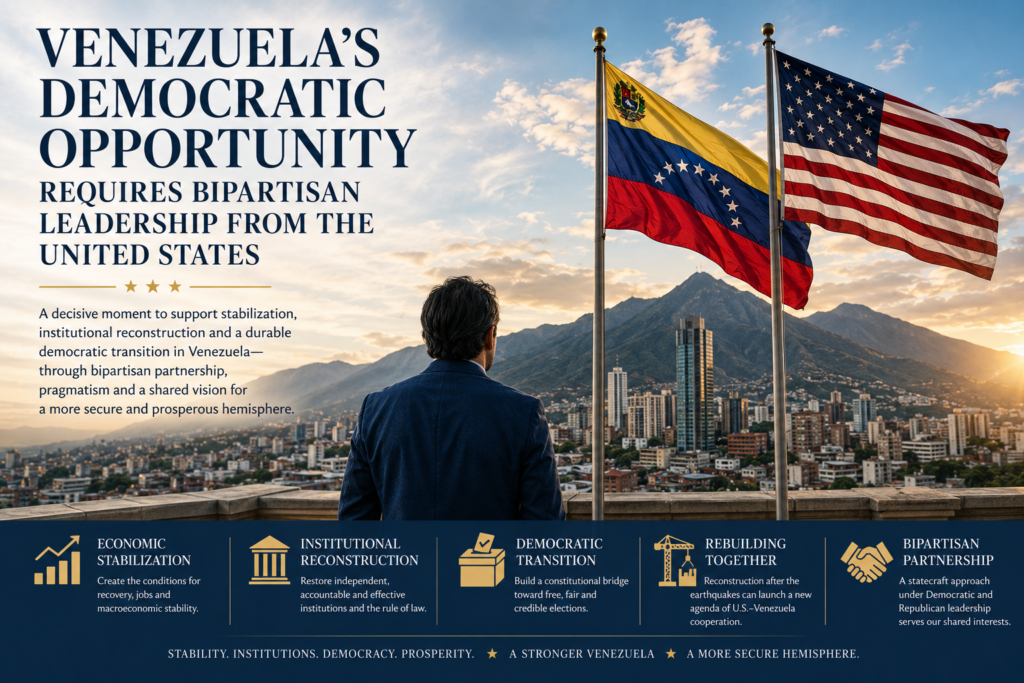
The political arrangements that emerged after January 3 remain imperfect and incomplete. Yet they have opened space for institutional reconstruction and economic reform. The concept of a three-phase process—stabilization, economic recovery, and democratic transition—provides a useful framework for understanding the current moment. Even after the June earthquakes, the IMF projects real GDP growth of roughly 4 percent this year, while some private-sector analysts foresee substantially stronger growth in 2027 if reconstruction and political normalization continue. Inflation and currency depreciation remain major challenges, although both can be brought under control if disciplined macroeconomic policies are implemented.
Economic reopening alone will never be enough. Markets cannot replace institutions. Investment cannot substitute for legitimacy. I count myself among those who insist on a clear electoral horizon. Yet creating the political conditions for credible elections requires a functioning economy. There is no better legacy for a newly elected democratic government than to inherit a stabilized economy rather than a nation trapped in economic freefall and social unrest.
The dialogue taking shape between Venezuela’s current National Assembly and representatives of the 2015 National Assembly offers an opportunity to restore judicial independence, rebuild constitutional checks and balances, appoint an independent National Electoral Council, and prepare internationally credible elections. It also provides a constitutional bridge between today’s pragmatic arrangements and tomorrow’s democratic legitimacy.
The June 24 earthquakes make these reforms even more urgent. Reconstruction should become the foundation of a new bilateral partnership encompassing infrastructure, investment, emergency management, organized crime, migration, energy security, and Caribbean and hemispheric stability.
Migration policy should reflect that same strategic vision. A thirty-six-month Deferred Enforced Departure (DED) for eligible Venezuelans would provide stability for families while giving Venezuela time to consolidate democratic reforms and reconstruction. It would align immigration policy with broader American foreign policy objectives.
The United States should continue championing democratic institutions, human rights, strategic clarity, economic growth, investment, and regional security. A bipartisan framework can preserve what is working, improve what is not, and provide the continuity that successful democratic transitions require.
To my fellow Democrats, I would simply say this: we should be constructive and keep Venezuela outside the partisan polarization that increasingly defines American politics. We have done so before. We can do so again.
Twenty-one years ago, I left Venezuela because democracy had failed, and I found myself and family at risk. This summer, I returned because democracy has another chance.
Venezuela’s democratic opening should not become another casualty of America’s partisan divisions. It deserves bipartisan leadership because the Venezuelan people deserve the opportunity to succeed. History will not remember which political party claimed credit. It will remember whether, when democracy was given another chance in the Americas, the United States was wise enough to help it succeed.