

“The United States can help, but not through a logic of tutelage. It is in the U.S. interest for Venezuela to be reintegrated into the Western Hemisphere as a country governed by the rule of law, legal certainty, and checks and balances. And that can only be guaranteed by democracy and a path agreed by broad sectors within Venezuela. Autocracies have already proven incapable of providing stability or predictability”
“The oil industry must also serve as a lever for developing opportunities and capabilities within Venezuela’s domestic business sector and national human capital.”
Antonio Ecarri Angola is a Venezuelan opposition legislator, educator, and political leader who has emerged as one of the most consistent voices advocating for institutional reform, social inclusion, and a pragmatic path toward democratic recovery. A member of Venezuela’s National Assembly and founder of the political movement Alianza del Lápiz, Ecarri was a presidential candidate in the July 28, 2024 elections, running on a platform centered on education, social mobility, and economic reintegration.
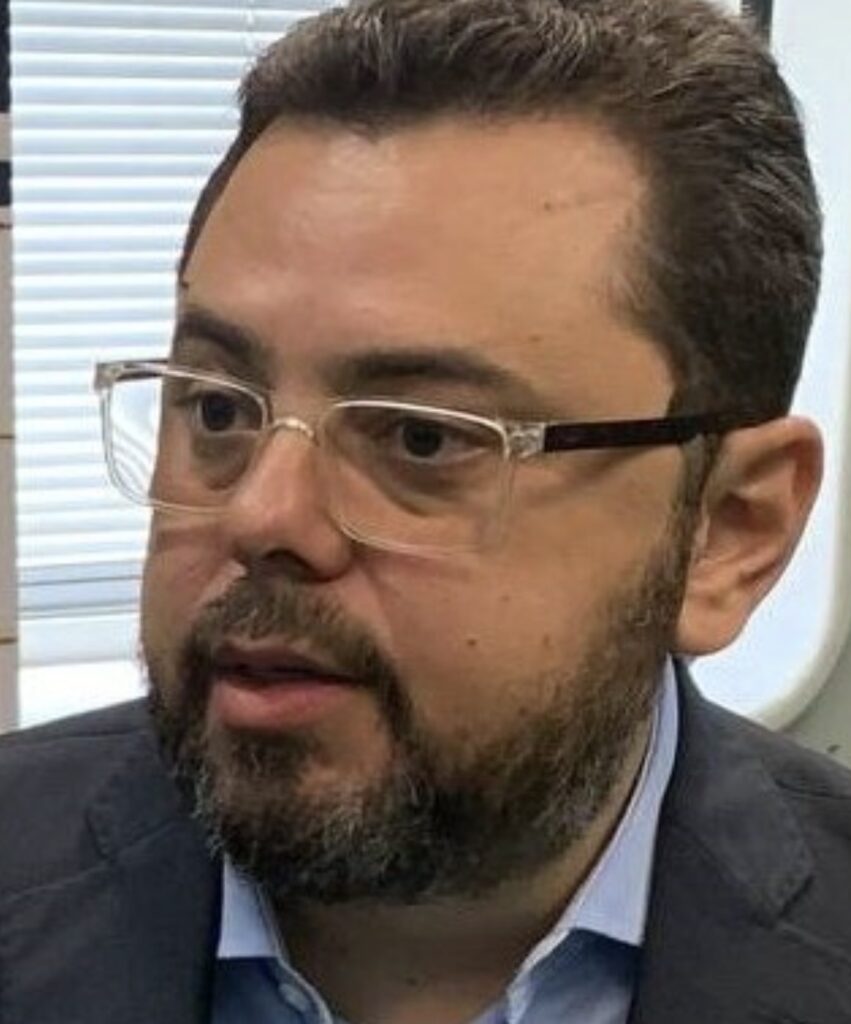
Known for his rejection of both authoritarianism and political maximalism, Ecarri has argued for a gradual, constitutional, and law-based process of change in Venezuela. In the legislature, he has focused on structural reforms—most notably a comprehensive proposal to reform the Organic Law of Hydrocarbons—aimed at restoring transparency, limiting discretionary power, and ensuring that oil revenues translate into national development. His approach emphasizes institutional credibility, rule of law, and economic inclusion as preconditions for any sustainable democratic transition.
Antonio Ecarri has advanced a thesis that challenges both the government and the traditional opposition: Venezuela will not overcome its crisis through abrupt ruptures or epic shortcuts, but through a gradual, serious, and verifiable process of institutional reconstruction. That vision is clearly reflected in his proposal to reform the Organic Law of Hydrocarbons and in his broader understanding of the political path the country must follow. Here is our conversation with Assemblyman Ecarri:
IQL: Congressman Ecarri, you presented a detailed proposal to reform the Hydrocarbons Law which passed this week without your amendment. Why do you consider this law to be so central to Venezuela’s current political moment?
Ecarri: Because oil is not just another sector of the economy—it is the axis that conditions national life as a whole. Venezuelan history shows that as long as oil is managed with discretion, opacity, and excessive concentration of power, there can be neither stability nor democracy. Our proposal seeks to remove oil from personalistic political control and return it to clear, technical, and transparent institutional rules.
IQL: One of the core elements of your proposal is the creation of a National Hydrocarbons Agency. What problem is this intended to solve?
Ecarri: Hyper-presidential control over the oil sector. For decades, too many strategic decisions have depended on a single official or a small political circle. That produces regulatory arbitrariness, corruption, and legal uncertainty. The National Hydrocarbons Agency we propose would be a technical, autonomous body with accountability mechanisms, capable of regulating the sector based on professional criteria rather than political expediency.
IOL: You have said that the reform approved by the Assembly is incomplete. In what sense?
Ecarri: The reform dismantles part of the extreme statism that led the country to ruin, but it leaves a serious problem intact: it concentrates enormous powers in the Ministry of Hydrocarbons. A kind of “super-minister” is created, with authority to raise or lower royalties, approve or cancel contracts, and authorize commercialization schemes. Without institutional counterweights, that is extremely risky for the country.
IQL: Why do you place such emphasis on oil-sector transparency as a core condition of reform?
Ecarri: Because oil-sector opacity has been the breeding ground for the most scandalous corruption in our history. Without public contracts, payment traceability, or identification of ultimate beneficiaries, oil is reduced to a tool of political patronage rather than a source of public value. Transparency is not ideology—it is a minimum condition for oil revenues to return to citizens rather than to corrupt networks.
IQL: You have also spoken about the need to include rules ensuring that procurement of goods and services benefits Venezuelan businesses. Was that achieved?
Ecarri: I have said—and I insist—that the reactivation of the oil industry through foreign investment is inevitable and necessary. Venezuela needs capital, technology, and access to international markets. But that reactivation cannot become an enclave disconnected from the real country.
The oil industry must also serve as a lever for developing opportunities and capabilities within Venezuela’s domestic business sector and national human capital. Service companies, industrial suppliers, engineers, technicians, and professionals exist, yet remain underutilized. This should have been clearly embedded in the law. It was not done as it should have been, but we are still in time to make it possible through complementary regulations, clear rules, and coherent public policies. If oil once again generates wealth without translating into opportunities for Venezuelans, we will have repeated the historic mistake.
IQL: How does this oil agenda connect to the broader political debate about Venezuela’s transition?
Ecarri: This is the key point: without a functioning economy, there is no peace; without peace, there is no viable political process. That is why I argue that what Venezuela is experiencing today is not truly a transition, but rather a process of tension that must be managed step by step, with rationality and clearly defined objectives.
IQL: You often cite the Spanish transition as a reference. What lessons do you believe apply to Venezuela?
Ecarri: “From law to law, through law.” That is how Professor Torcuato Fernández Miranda defined the Spanish transition. Any change had to take place from law to law, through law—without violence or ruptures. At that time, Spain had already suffered too much: more than half a million deaths in a civil war and decades of dictatorship.
The maturity of that political class allowed adversaries to come to an understanding. Adolfo Suárez—whom many forget—had been a minister under Franco, secretary-general of the Francoist movement, and head of Spanish state television. That fact is often erased from memory, but it was central to understanding how change became possible. Today, despite the many historical and political differences, Venezuelans have an opportunity to move forward with calm and restraint, as General Eleazar López Contreras once put it.
IQL: Some sectors reject any comparison with Spain because of historical differences. How do you respond?
Ecarri: The contexts are obviously different. But there are universal principles: without institutions, without rules, and without minimum agreements, there is no sustainable way forward. Venezuela must avoid shouting, avoid noise, and advance with firm steps toward democratization.
In that sense, it was somehow refreshing—amid so much uncertainty—to hear Marco Rubio mention in his testimony before the U.S. Senate that lessons could be drawn from the Spanish transition, emphasizing the importance of it being integrated and inclusive. I would reiterate that any such process must take place within the Constitution and the law—principles that all of us must embrace if this process is to succeed.
IQL: You have said that oil introduces an additional layer of complexity compared to the Spanish case. Why?
Ecarri: Because here there is an economic fact that permeates everything. Oil defines the lives of Venezuelans. We entered international oil competitiveness twenty-seven years late, but we cannot keep postponing it. A country whose reserves belong to its people cannot continue to live in extreme poverty, inequality, and corruption as a result of discretionary control over that wealth.
IQL: What should be the first concrete steps in this process of change?
Ecarri: Before any election, we need a credible electoral authority (CNE). And, Venezuela needs deep institutional reforms: renewal of the Judiciary, renewal of the Citizen Power institutions—the Prosecutor General’s Office, the Comptroller General, the Ombudsman—and a legal framework that guarantees the rule of law. Elections must be the consequence of a broad national political pact that restores institutional credibility, not an empty starting point.
IQL: Where does the international community—particularly the United States—fit into this process?
Ecarri: The United States can help, but not through a logic of tutelage. It is in the U.S. interest for Venezuela to be reintegrated into the Western Hemisphere as a country governed by the rule of law, legal certainty, and checks and balances. And that can only be guaranteed by democracy and a path agreed by broad sectors within Venezuela. Autocracies have already proven incapable of providing stability or predictability.
IQL: Finally, what is the ultimate objective of the roadmap you are proposing?
Ecarri: To arrive, step by step, at genuine electoral legitimacy, grounded in credible institutions, so that Venezuela can once again become a reinstitutionalized, democratic, and sovereign state. No shortcuts, no ruptures, no false epics—only law, a functioning economy, and institutions that serve citizens.