

Venezuela returned decisively to the center of Washington’s policy agenda this week. Energy revenues, sanctions enforcement, legal disputes, and high-level political symbolism converged into a moment that could shape both U.S. strategy and Venezuela’s internal transition dynamics.
From the consolidation of oil revenue oversight under U.S. control to the Capitol appearance of opposition figure Enrique Márquez, developments this week underscored how economic leverage and political signaling are now intertwined in the evolving U.S.–Venezuela relationship.
Oil Revenues Move from Qatar to Direct U.S. Oversight
In a significant shift, the U.S. Department of the Treasury confirmed that Venezuelan oil proceeds will no longer be routed through previously established accounts in Qatar. Those accounts had functioned as a neutral holding mechanism designed to shield funds from creditor claims amid Venezuela’s sovereign debt disputes.
Under revised arrangements, oil revenues are now being deposited into accounts under U.S. Treasury oversight — a move following executive action by President Donald Trump. Administration officials describe the change as a measure to ensure transparency and prevent seizure by bondholders or other claimants.
The financial scale is substantial. U.S. officials project that oil sales under the current framework could reach approximately $2 billion by the end of February 2026, with initial January and early February shipments already exceeding $1 billion. The figures highlight both Venezuela’s partial reintegration into monitored oil markets and the degree of leverage Washington now holds over its principal export revenue stream.
Supporters frame the arrangement as custodial stewardship pending democratic normalization. Critics argue it deepens U.S. entanglement in Venezuela’s sovereign financial architecture.
Sanctions Enforcement and Legal Friction Continue
Enforcement mechanisms remained active this week. The U.S. Department of Justice advanced a civil forfeiture complaint seeking seizure of nearly 1.8 million barrels of Venezuelan crude aboard the Motor Tanker Skipper, alleging sanctions evasion.
Meanwhile, litigation continues in federal court involving Nicolás Maduro, who faces charges in Brooklyn. His defense team is contesting actions by the Office of Foreign Assets Control (OFAC) that reversed authorization allowing frozen Venezuelan state funds to be used for legal defense.
Maduro’s attorney argues that restricting access to sovereign funds raises due process concerns. Federal authorities maintain that sanctions compliance remains binding. The case tests the outer limits of U.S. sanctions law: whether designated foreign leaders may access blocked assets to finance their defense.
Venezuela at the State of the Union
Venezuela also featured in President Trump’s State of the Union address, where he cited Venezuelan oil flows as evidence of strategic leverage and policy effectiveness. The remarks placed energy geopolitics squarely within the administration’s domestic narrative.
Yet the most resonant Venezuela-related moment of the evening was personal rather than procedural.
Seated in the House chamber was Enrique Márquez, recently released Venezuelan opposition figure and former presidential candidate. His presence — highlighted during the address — carried immediate symbolic weight.
Capitol Symbolism and the Transition Debate
Márquez’s Capitol appearance sparked rapid political interpretation across Venezuela and the diaspora.
Some analysts view his elevation in Washington as a deliberate signal — positioning him as a pragmatic institutional actor who could serve as a bridge in a negotiated democratic transition. A former National Assembly member, Rector of the CNE (National Elections Board), and independent presidential candidate, Márquez occupies a political space distinct from both maximalist opposition factions and entrenched regime structures.
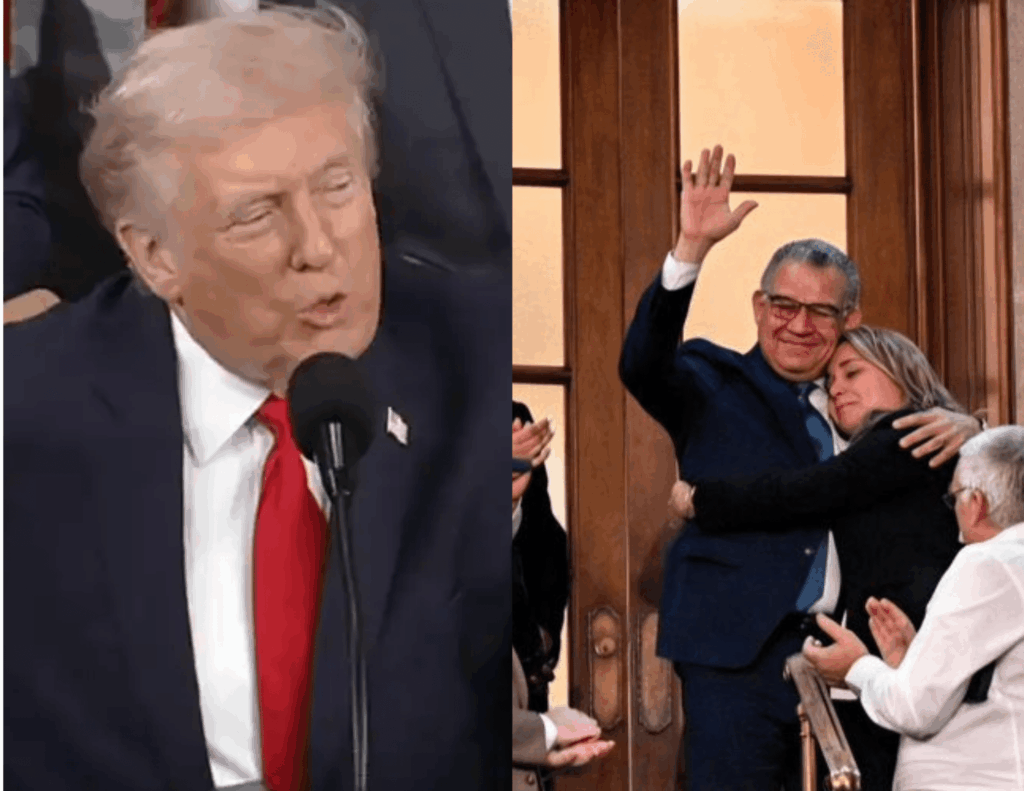
One of the most visible reactions in DC came from Leopoldo Martínez Nucete, former Venezuelan congressman, Biden administration senior official at the Department or Commerce, and Co-Chair of the Venezuelan American Caucus, one of the most influential Venezuelan-American advocacy organizations engaging Latino leadership networks in Washington.
Martínez described the recognition of Márquez in Washington as “a fundamental step for the freedom of Venezuela,” framing the moment as a meaningful signal within the broader reinstitutionalization process. His assessment reflects a current within the Venezuelan-American diaspora that views Washington’s symbolic gestures as consequential in shaping transition momentum.
In polarized and fluid political environments, recognition can translate quickly into relevance.
Machado Speculation and Opposition Realignment
Márquez’s prominence this week has also fueled speculation about the positioning of María Corina Machado, one of the most mobilizing figures in Venezuela’s democratic movement.
Machado maintains strong grassroots legitimacy and remains central to opposition activism. However, her absence from this week’s Washington spotlight has prompted chatter among political observers that U.S. engagement may be broadening beyond a single leadership axis.
There is no formal indication that the White House has shifted support away from Machado. Nonetheless, in transitional contexts, symbolic visibility carries strategic weight. Diversification of interlocutors can reshape internal balances of influence, particularly when external actors control significant economic leverage.
An Inflection Point in U.S.–Venezuela Policy
This week’s developments reflect a dual-track approach:
- Financial consolidation: Direct Treasury oversight of oil revenues.
- Active enforcement: Continued maritime interdictions and forfeiture actions.
- Legal testing: Sanctions law challenged in federal court.
- Political signaling: High-level symbolic recognition of emerging figures.
As oil revenues approach the projected $2 billion mark for February and opposition dynamics continue to evolve, Washington’s financial and symbolic choices are increasingly shaping the architecture of any prospective negotiated transition.
For now, Venezuela remains not only an energy file in U.S. foreign policy, but a live test case of how economic leverage, sanctions authority, and political legitimacy intersect in moments of democratic flux.