

Back in Venezuela, Márquez struck a careful tone. He urged unity and reconciliation at a moment of profound transition, calling for a collaborative rebuilding of democratic institutions rather than revenge politics.
WASHINGTON/CARACAS – When Enrique Márquez, a former Venezuelan presidential candidate and recent political prisoner, walked onto the stage of the U.S. Congress during the 2026 State of the Union address, it was more than an emotional family reunion. It was a deliberate signal — one that has reverberated not only in Washington but across divisions within Venezuela’s fractured democratic opposition.
President Donald Trump personally highlighted Márquez, introducing him from the gallery and celebrating his release from prison following the ouster of Nicolás Maduro. The moment — broadcast around the world — elevated Márquez in a way few Venezuelan opposition figures have experienced on the global stage.
For many in Washington who had never heard his name before, the questions began almost immediately: Who is Enrique Márquez, and why him?
A Career Between Institutions and Opposition
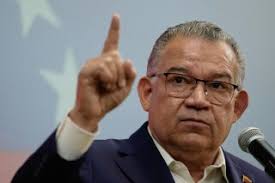
Born in Maracaibo in 1963, Márquez is an engineer with graduate studies in London, and long-time political actor. He served as Vice President of Venezuela’s National Electoral Council (CNE) from 2021 to 2023, a role that placed him at the heart of his country’s contentious electoral system.
Unlike many opposition leaders who operate outside state institutions, Márquez’s early strategy was to push for reform from within — advocating for transparency of electoral processes even as the CNE was widely accused of bias under the Maduro government.
This approach set him apart from figures more inclined to outright rejection of state mechanisms — but it also left him vulnerable to political backlash once he moved from regulator to challenger.
The 2024 Election and His Detention
In the controversial July 28, 2024 presidential election — widely denounced by international observers for lack of transparency — Márquez ran as a candidate alongside a crowded field. His campaign stressed electoral guarantees and institutional reform.
After the official results declared incumbent Nicolás Maduro the winner despite strong evidence to the contrary indicating Mr. Edmundo González was the clear winner, Márquez (who received marginal support in the vote) publicly challenged the process and sought legal redress.
On January 7, 2025, just days before the contested inauguration, he was detained by security forces. His imprisonment was one of many seen as part of a broader crackdown on opposition voices in the aftermath of the election. He spent more than a year in detention before being released in January 2026 as part of a larger political prisoner release under the new transitional government.
A Complicated Reception at Home — and Abroad
Márquez’s appearance in Washington was significant not only for its symbolism — spotlighting political repression in Venezuela — but also because of who was not standing beside him.
In the months leading up to the State of the Union, U.S. Senator Rick Scott extended an invitation to Venezuelan opposition leadership. Notably absent from the Capitol that night was María Corina Machado, the leading figure of the main opposition coalition (Plataforma Unitaria) and one of the most prominent Venezuelan political voices on the international right.
Machado’s camp declined the invitation, a decision that underscored deep strategic and ideological differences within Venezuela’s opposition. Some analysts suggested that her instinct to avoid association with what she and her allies view as transactional political signals from Washington — or as contradictory to her narrative of uncompromising opposition to any authoritarian successors — helped shape her absence.
That absence was highlighted when, at the Caracas press conference after his return from Washington, Márquez revealed that he had not heard from Machado since his release from prison — a stark indicator of the growing divide among opposition leaders.
A Press Conference in Caracas
Back in Venezuela, Márquez struck a careful tone. He urged unity and reconciliation at a moment of profound transition, calling for a collaborative rebuilding of democratic institutions rather than revenge politics. He acknowledged his prison ordeal, detailed harsh conditions, and expressed gratitude for the international attention that helped spotlight political repression at home.
But his remarks — while conciliatory — also hinted at the uncomfortable realities within the opposition. His acknowledgment that he had not been contacted by Machado, one of his most prominent political contemporaries, revealed how deeply politics have diverged among leaders who once shared broad goals but not methods or alliances. Márquez did not shy away from acknowledging a personal and political debt — particularly to former Spanish prime minister José Luis Rodríguez Zapatero, whom he described as a close friend and key mediator in securing the release of hundreds of political prisoners, including himself. Márquez said Zapatero “behaved like a brother” to his wife and family during his unlawful detention and that he held deep gratitude for the European leader’s efforts, emphasizing that Zapatero had offered support when it was needed most. That public praise, however, has proved punctually controversial within Venezuela’s democratic opposition. Many supporters in the camp of María Corina Machado view Zapatero with deep skepticism because of his past engagements with the Chávez and Maduro governments — engagements they argue lent political legitimacy to an authoritarian regime, using this as ammunition against Marquez, despite the contradiction that Edmundo González the purpoted winner of the electoral formula led by Machado, like Márquez, has expressed gratitude to Zapatero for his efforts to negotiate Gonzalez’s asylum in Spain.
One of the more striking moments in Márquez’s press conference in Caracas was his candid assessment of the current political reality: “Like it or not,” he said, Delcy Rodríguez is the person in charge of the presidency — a position she assumed following the capture of Nicolás Maduro and with the active support or de facto recognition of the United States in the transitional phase. Rather than dismissing or delegitimizing her role, Márquez took what he described as a pragmatic stance; he insisted that opposition strategy must be constructive and vigilant to ensure that the ongoing process ultimately leads to a credible transition to democracy rather than stagnation or re-entrenchment of authoritarian practice. He emphasized that certain conditions and reforms — institutional guarantees, transparent electoral frameworks, and protections for civil and political rights — need to be firmly in place before a genuinely free and fair election can be held, a position reflecting both realism about present power dynamics and an insistence on principled objectives.
Márquez went further: he said he would not hesitate to support any genuinely positive reforms initiated by Rodríguez, particularly those that expanded civic space or advanced democratic norms. But he also made clear that he would be a vigorous critic and advocate if decisions taken by the interim government diverged from the fundamental aim of achieving democratic transition and electoral credibility. This careful balance — between cooperation on constructive change and principled opposition to backsliding — signals an effort to navigate the delicate political terrain of a Venezuela in flux, where navigating de facto power structures and defending democratic principles are no longer mutually exclusive but deeply intertwined.
What His Spotlight Means
For Washington policymakers, Márquez’s story served multiple strategic purposes:
- It personalized the narrative of political repression in Venezuela.
- It elevated a figure who combines institutional experience with electoral challenge to the old regime.
- And it signaled U.S. interest in supporting alternative voices within the opposition during a transitional moment.
But domestically, it has sharpened debates about leadership, strategy and who represents the future of Venezuela’s democratic aspirations.
As Márquez himself has suggested, Venezuela may be entering a moment where the old binaries of opposition politics are giving way to new configurations — some rooted in institutional pragmatism, others in uncompromising ideological resistance.
For now, his sudden prominence is a reminder that, in post-Maduro Venezuela, politics remains unpredictable — and deeply contested both at home and abroad.