

Washington Desk — A series of developments this week confirmed a significant shift in the relationship between Washington and Caracas. Diplomatic channels are reopening, economic engagement is expanding, and a complex political transition in Venezuela is unfolding under close U.S. scrutiny.
A series of developments in Washington and Caracas this week confirm that U.S.–Venezuela relations are entering a new phase defined by pragmatic engagement, strategic economic interests, and continued political leverage.
Within a matter of days, the United States and Venezuela agreed to restore diplomatic and consular relations; new pathways for U.S. energy investment were clarified; commercial flights between both countries were approved; U.S. officials traveled to Caracas with mining companies to explore strategic minerals; and a gold commercialization agreement involving Venezuela’s state mining company received authorization under the U.S. sanctions framework.
Taken together, these developments reveal an emerging architecture in Washington’s approach to Venezuela — one that combines economic normalization with political conditionality.
Diplomatic Relations Restored
The most consequential institutional development of the week was the decision by the United States and Venezuela’s interim authorities to restore diplomatic and consular relations, reopening formal channels that had effectively been suspended for years.
In a communiqué issued in Caracas on March 5, the Venezuelan government confirmed that both countries had agreed to reestablish diplomatic ties following recent dialogue between officials from both governments. The statement described the move as the beginning of “a new stage of constructive dialogue based on mutual respect, sovereign equality, and cooperation between our peoples.”
The U.S. Department of State confirmed the agreement the same day, emphasizing that renewed diplomatic relations are intended to facilitate stability, support economic recovery, and advance political reconciliation in Venezuela.
While Caracas framed the decision primarily in terms of sovereignty and cooperation, Washington presented the reopening as part of a broader effort to help create the conditions for a peaceful democratic transition.
Despite these differences in emphasis, the restoration of diplomatic relations represents a significant shift after years of estrangement and provides the institutional framework for sustained dialogue between both governments.
Equally important, the reopening of consular channels could have immediate practical implications. For the Venezuelan diaspora in the United States — numbering hundreds of thousands — the restoration of consular services may eventually allow long-delayed processes such as passport renewals, identity documentation, and legal certifications to resume.
The Delcy Rodríguez Equation
At the center of this evolving diplomatic landscape stands Venezuela’s acting president Delcy Rodríguez, who assumed power earlier this year following the arrest of Nicolás Maduro.
Rodríguez has moved quickly to stabilize relations with Washington. Her government has supported reforms to Venezuela’s hydrocarbons framework, overseen the passage of an amnesty law that led to the release of political detainees, and hosted several senior U.S. officials in Caracas.
President Donald Trump publicly praised Rodríguez this week in a Truth Social post, writing: “Delcy Rodríguez, who is the President of Venezuela, is doing a great job, and working with U.S. Representatives very well. The Oil is beginning to flow.”
The wording was notable. By referring to Rodríguez as “the President of Venezuela,” Trump appeared to signal a level of political recognition that goes beyond routine diplomatic engagement. In the context of Venezuela’s ongoing transition, the statement carried symbolic weight, reinforcing Washington’s willingness to work directly with Rodríguez as the country’s acting authority while broader questions about Venezuela’s political future remain unresolved.
For diplomats, investors, and political actors following Venezuela closely, the phrasing also functions as a strategic signal: the United States is prepared to treat Rodríguez as the operational counterpart for the current phase of engagement, even as Washington continues to frame its broader policy around the goal of democratic transition.
In practical terms, the message from Washington appears clear: cooperation with Rodríguez’s government is currently the channel through which the United States intends to manage Venezuela’s transition, economic reopening, and reintegration into global markets.
Yet the political environment remains sensitive.
A Reuters report earlier in the week suggested that U.S. prosecutors in Miami had been preparing a criminal indictment against Rodríguez related to alleged corruption and money laundering involving Venezuela’s state oil company PDVSA.
The report was immediately disputed by the U.S. Department of Justice. Deputy Attorney General Todd Blanche publicly stated that the report was “completely false,” while Reuters subsequently reaffirmed its reporting citing unnamed sources.
The episode reflects the delicate political balance surrounding the current engagement. While Washington retains significant legal and political leverage over Venezuelan officials, the administration is simultaneously seeking to maintain cooperation during a transitional period.
Against this backdrop, Rodríguez has demonstrated notable political pragmatism. Managing a situation in which the United States offers engagement while maintaining potential legal pressure requires careful navigation both domestically and internationally.
So far, she appears to have handled that balance with relative competence, maintaining dialogue with Washington while preserving support among key political actors within Venezuela during a highly fragile moment in the country’s political evolution.
Notably absent from the current phase of engagement is any explicit U.S. emphasis on the immediate political return of opposition leader María Corina Machado or on a concrete electoral timetable.
While Washington continues to frame its broader policy around democratic transition, recent signals from the Trump administration suggest that these issues are not currently at the center of active negotiations with Caracas.
For many observers in Washington and within Venezuela’s opposition, this silence is itself meaningful. It suggests that the administration’s immediate priority may be stabilizing Venezuela’s political transition and facilitating economic reopening — particularly in the energy and strategic minerals sectors — rather than pressing for near-term electoral competition.
In that sense, the current diplomatic moment reflects a pragmatic calculation: manage the transition first, and address the electoral horizon later.
Oil Diplomacy and Energy Reengagement
Energy remains the central pillar of renewed economic engagement.
The U.S. Treasury Department’s Office of Foreign Assets Control issued new guidance this week clarifying general licenses that allow U.S. companies to conduct due diligence, import equipment and services, and negotiate potential investments in Venezuela’s oil and gas sector under defined conditions.
At the same time, the U.S. Department of Transportation approved the resumption of American Airlines flights between Miami and Caracas, restoring direct commercial connectivity between the two countries for the first time in years.
Chevron continues to operate in Venezuela under a special license and currently produces roughly 250,000 barrels per day, representing a significant share of Venezuela’s total oil output.
Meanwhile, ExxonMobil signaled interest in reassessing Venezuela’s energy sector, announcing plans to send a technical team to evaluate infrastructure and potential investment opportunities — a potentially important development given the company’s absence from the country since the nationalizations of the Chávez era.
Strategic Minerals and the Critical Resources Agenda
Washington’s engagement with Caracas is not limited to oil.
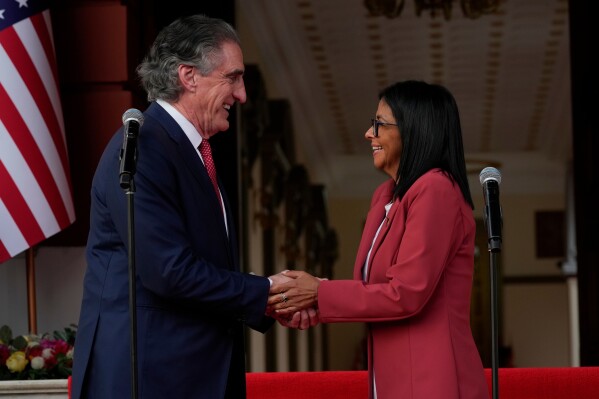
Interior Secretary Doug Burgum traveled to Venezuela this week accompanied by representatives from more than two dozen U.S. mining companies to explore opportunities in the country’s mineral sector, including gold, copper, coltan, bauxite, and other strategic resources.
These minerals are essential for supply chains tied to semiconductors, defense technologies, and electric vehicles.
Venezuelan authorities announced plans to introduce reforms to the country’s mining law aimed at attracting foreign investment and improving regulatory conditions.
For Washington, integrating Venezuela into Western-aligned supply chains for critical minerals aligns with a broader strategic objective: reducing global dependence on China for key industrial inputs.
Gold Trade and the Minerven–Trafigura Channel
A parallel development illustrates how economic normalization may begin to unfold through specific licensed transactions.
Venezuela’s state mining company Minerven recently signed a gold commercialization agreement with global commodities trader Trafigura, under which Venezuelan gold doré bars will be supplied to international refiners.
The transaction reportedly received authorization under a license issued by the U.S. Treasury’s Office of Foreign Assets Control, allowing the deal to proceed despite the broader sanctions framework.
The shipment — estimated between 650 and 1,000 kilograms of gold — could represent a transaction valued at more than $100 million depending on purity and market prices.
Large global commodity traders such as Trafigura often serve as intermediaries in politically sensitive markets, helping structure transactions that comply with regulatory frameworks while reopening supply channels.
The agreement illustrates a key feature of the emerging policy approach: rather than lifting sanctions wholesale, Washington appears to be allowing controlled economic reentry through specific licenses and monitored commercial channels.
Engagement With Leverage
Taken together, the developments of the week reveal a hybrid strategy emerging in Washington’s Venezuela policy.
The United States is opening pathways for economic engagement — particularly in oil, mining, and commodities — while simultaneously maintaining legal and political tools that preserve leverage over Venezuela’s leadership.
For Caracas, renewed diplomatic relations and selective economic reopening represent an opportunity to stabilize the country’s economy and rebuild international legitimacy.
Whether this evolving relationship ultimately leads to deeper normalization or remains a conditional engagement tied to Venezuela’s political transition remains uncertain.
What is clear, however, is that after years of diplomatic rupture and economic isolation, Venezuela has once again become a central strategic issue in Washington’s hemispheric policy.