

Pollster Félix Seijas says public priorities reveal a widening gap between citizens and Venezuela’s political leadership
Analysis by IQ Latino Desk with Editorial Board Notes, based on reporting by José Gregorio Yépez for Contrapunto.com
As discussions about Venezuela’s political future intensify—both inside the country and among policymakers in Washington and across Latin America—much of the debate continues to revolve around electoral strategy, sanctions policy, and leadership disputes within the opposition.
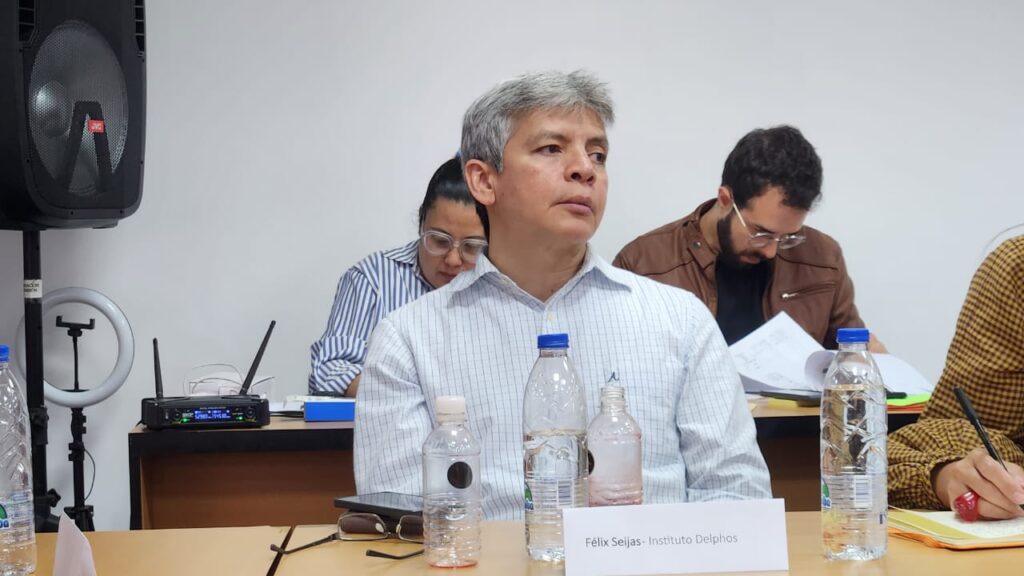
Yet public opinion data suggests that the concerns of Venezuelans on the ground may be far more immediate and practical. In an interview with journalist José Gregorio Yépez for Contrapunto.com, Venezuelan pollster Félix Seijas, director of the research firm Delphos, offers a revealing perspective: for most Venezuelans today, the central priority is not political branding or loyalty to leaders, but the recovery of basic living conditions.
A Society Focused on Recovering Daily Life
After more than a decade of economic collapse, hyperinflation, and institutional crisis, Venezuelan society appears increasingly focused on restoring normalcy.
“The priority for people today is the recovery of their living conditions,” Seijas said. “It is not about supporting brands or political personalities.”
His observation reflects a broader transformation in Venezuelan public attitudes. For many citizens, politics is no longer primarily about ideological alignment or partisan identity. Instead, it is evaluated through a pragmatic lens: whether it helps improve everyday life.
Years of declining wages, deteriorating public services, and mass migration have reshaped social expectations. Employment opportunities, income stability, functioning infrastructure, and access to healthcare and education have become the central concerns for much of the population.
In this context, Seijas suggests that Venezuelan society may be moving toward what could be described as a post-polarization social mood, in which economic recovery takes precedence over political identity.
The Limits of Polarized Politics
For much of the past twenty-five years, Venezuelan politics has been defined by intense polarization between the governing Chavista movement and its opposition.
Political identity—whether aligned with Chavismo or anti-Chavismo—often structured public discourse and electoral behavior.
But the prolonged economic crisis appears to be weakening those traditional alignments.
Public opinion data increasingly suggests that citizens are less interested in symbolic political battles and more concerned with tangible improvements in their daily lives. In practical terms, this means voters may judge political actors less on rhetoric and more on their ability to produce results.
This shift reflects a form of political fatigue, after years of confrontation that have yielded limited improvements for ordinary Venezuelans.
Implications for the Opposition’s Strategy Debate
Seijas’ findings come at a moment when Venezuela’s opposition is engaged in an ongoing debate about strategy.
Some leaders continue to emphasize a confrontational approach focused on political legitimacy and international pressure. Others have increasingly argued for more pragmatic strategies aimed at engaging Venezuelan society and rebuilding political institutions from within the country.
Figures such as María Corina Machado, who has emerged as one of the most influential opposition leaders in recent years, continue to frame the political struggle primarily around democratic legitimacy and institutional change. Her message has resonated strongly with sectors of the electorate demanding political transformation.
At the same time, other opposition voices—including former presidential candidate Enrique Márquez, as well as regional and civic leaders advocating institutional participation—have argued that the opposition must also develop strategies that respond more directly to the economic concerns of the population.
These leaders have emphasized the need to reconnect politics with the daily priorities of Venezuelans, focusing on governance, economic recovery, and institutional rebuilding.
The debate reflects a broader strategic question: how to reconcile the pursuit of democratic change with the immediate social and economic demands facing the country.
Lessons from Other Political Transitions
Historically, political transitions in other countries have often succeeded when political leadership aligned democratic aspirations with tangible improvements in economic conditions.
During Spain’s democratic transition in the late 1970s, for example, political reform was accompanied by economic stabilization efforts designed to address inflation and labor unrest. Similarly, Chile’s transition after the 1988 plebiscite combined institutional change with economic policies aimed at restoring growth and stability.
In Brazil, the gradual political opening of the mid-1980s also unfolded alongside economic debates about inflation, wages, and social policy.
These historical experiences suggest that democratic transitions often gain legitimacy when citizens perceive that political change is connected to improvements in their economic lives.
A Political Class Out of Sync
Seijas’ analysis ultimately points to a broader challenge facing Venezuela’s political class.
Much of the country’s political debate remains centered on leadership struggles, electoral disputes, and international dynamics. While these issues remain crucial to resolving Venezuela’s institutional crisis, they are not necessarily the primary lens through which many citizens view the country’s situation.
For millions of Venezuelans, the central question is simpler and more immediate: who can restore economic stability and improve living conditions?
Any viable political project—whether emerging from the government, the opposition, or a negotiated transition—may ultimately be judged by its capacity to deliver tangible improvements in wages, services, and economic opportunity.
“People are not mobilizing around brands,” Seijas said. “They are mobilizing around the hope of improving their lives.”
This article draws on reporting by José Gregorio Yépez, originally published by Contrapunto.com.