

IQ Latino DC/Caracas Desk | Week of March 20, 2026
Venezuela’s trajectory this week points to an increasingly defined equilibrium: political consolidation at home alongside pragmatic economic re-engagement abroad.
A cabinet reshuffle, the reassertion of control over CITGO, and a series of calibrated moves from Washington—most notably the operationalization of new sanctions licenses—suggest the country is entering a phase of managed stabilisation without parallel institutional reform.
Power Reconfigured
The removal of General Vladimir Padrino López, defence minister since 2014 and a central pillar of Venezuela’s civil-military balance, marks a structural shift in the regime’s internal architecture.
His replacement, General Gustavo González López, signals a move away from military institutional equilibrium toward intelligence-led control. A former head of SEBIN and military counterintelligence, González López is sanctioned by the United States and European Union and trained in psychological operations at the Escuela de las Américas (1991).
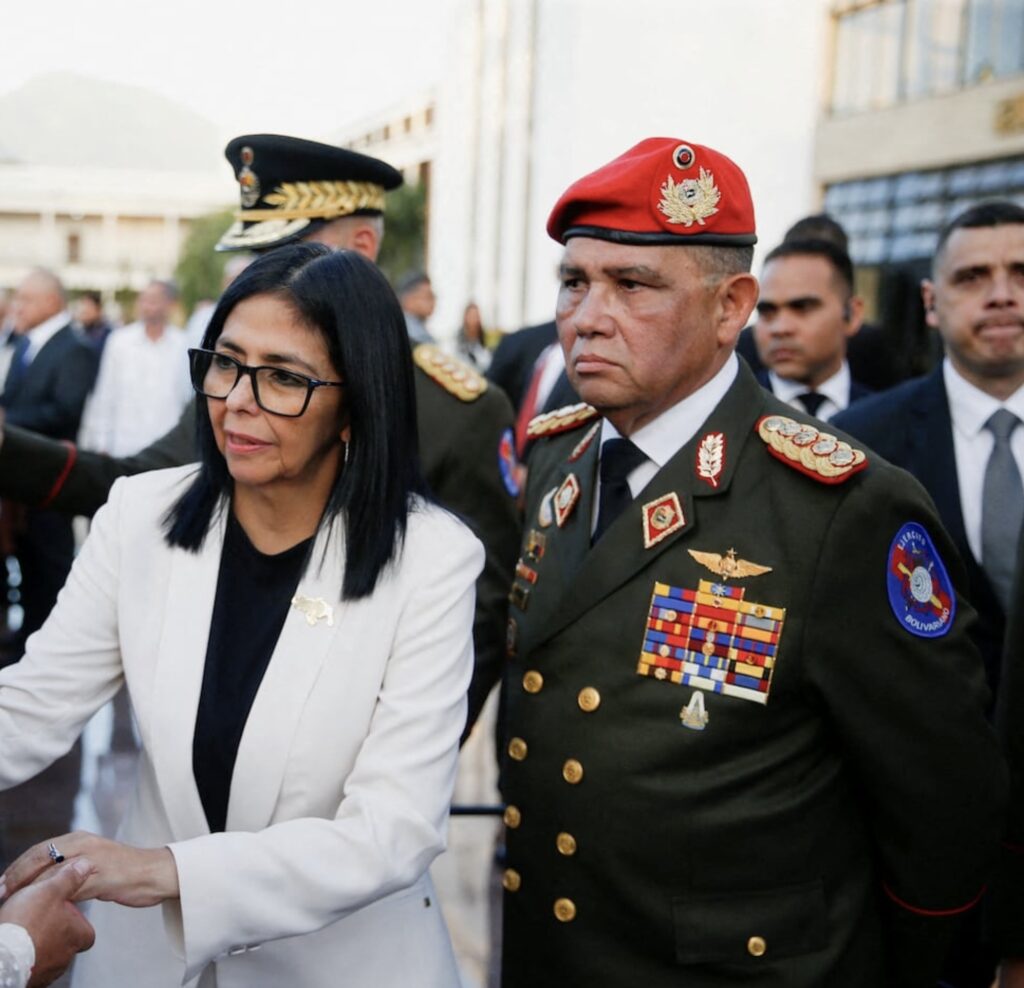
The shift is not cosmetic. It reflects a recentralisation of coercive power, consolidating authority under Delcy Rodríguez.
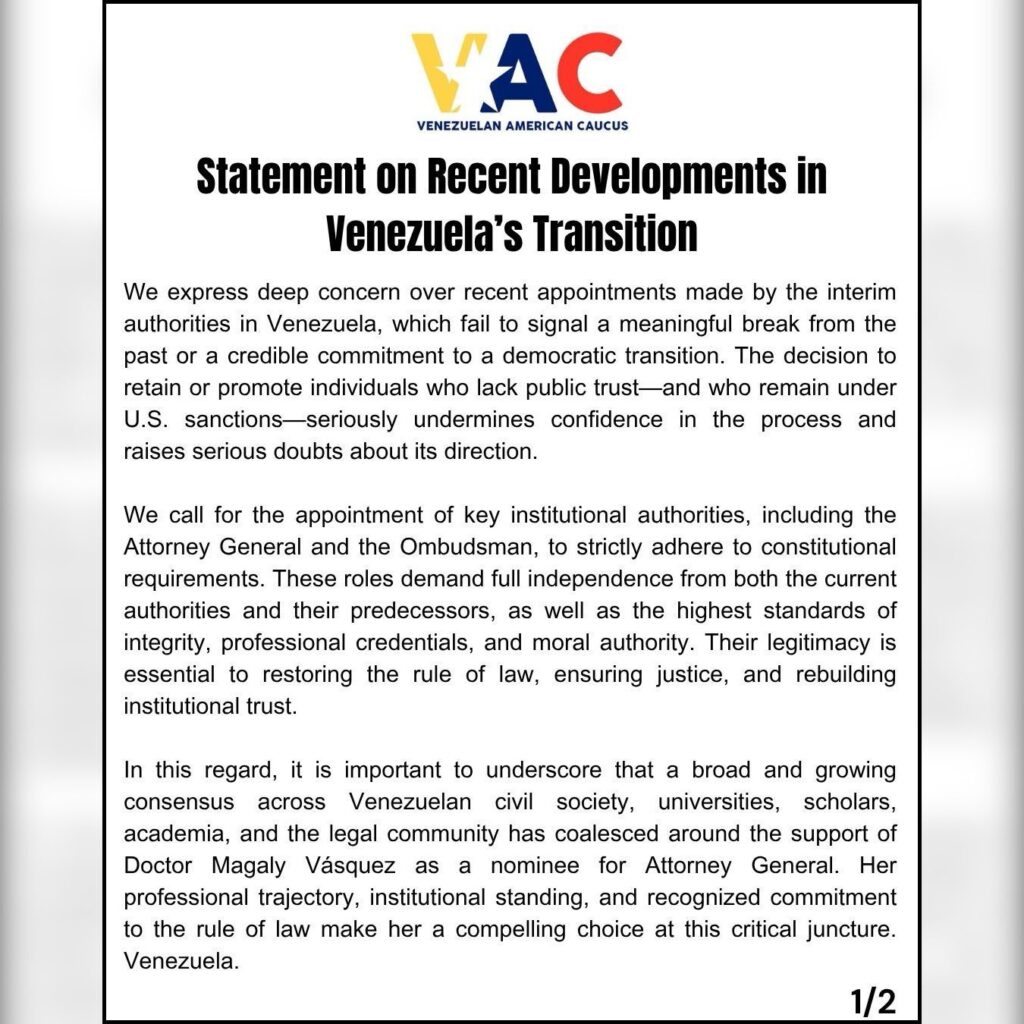
The broader reshuffle—spanning more than a dozen ministries—has prompted concern among civil society, legal experts, and diaspora organizations that the changes do not yet reflect a meaningful break with the past.
In a statement this week, the Venezuelan American Caucus (VAC) warned that recent appointments risk falling short of the institutional renewal required for a credible democratic transition, particularly where figures linked to prior governance structures or under international sanctions remain in positions of influence. The statement further stressed that the transition process must be anchored in constitutional procedures, institutional independence, and public trust, rather than administrative reshuffling alone.
VAC also reiterated two core demands:
- The appointment of an independent Attorney General, with broad support coalescing around Dr. Magaly Vásquez as a credible, consensus candidate
- The establishment of a clear and binding electoral timetable, without which current stabilization risks becoming politically indefinite

Alongside this hardening of political control, the cabinet reshuffle reveals a more nuanced trend: selective technocratic incorporation in key sectors.
- Rolando Alcalá, an engineer, assumes the electricity portfolio—tasked with stabilising a collapsing grid that remains a binding constraint on economic recovery
- Ana María Sanjuán, an academic linked to dialogue initiatives, takes over higher education, in what appears to be an effort to rebuild limited engagement with universities, long a core pillar of civil society
The emerging model is dual-track:
- Centralised political control
- Targeted technocratic pragmatism
CITGO: Control Reassumed, Risk Repriced
PDVSA has formally restructured the boards of its U.S. subsidiaries—PDV Holding, CITGO Holding, and CITGO Petroleum Corporation—with:
- Asdrúbal José Chávez Jiménez as President
- Directors including Nelson Ferrer, Alejandro Escarrá, and Ricardo Gómez
The significance lies not in the appointments themselves, but in what they represent: control without rupture.
CITGO remains at the center of a complex legal and geopolitical equation, where asset protection and creditor enforcement are advancing in parallel but not yet converging. The U.S. court in Delaware has moved forward with the auction process to satisfy outstanding claims against Venezuela, with a preferred bidder reportedly identified. However, any final transfer remains contingent on approval from the U.S. Treasury, which has renewed protections shielding CITGO from creditor attachment even after PDVSA-linked authorities reassumed control. This creates a dual dynamic: a judicial process progressing toward sale, and an executive branch retaining decisive authority through sanctions licensing. In practice, CITGO has evolved from a distressed asset into a strategic policy lever, where timing and outcome will likely be shaped not only by legal claims, but by broader U.S. objectives—balancing orderly creditor recovery, energy market stability, and leverage over Venezuela’s still-unresolved political transition.
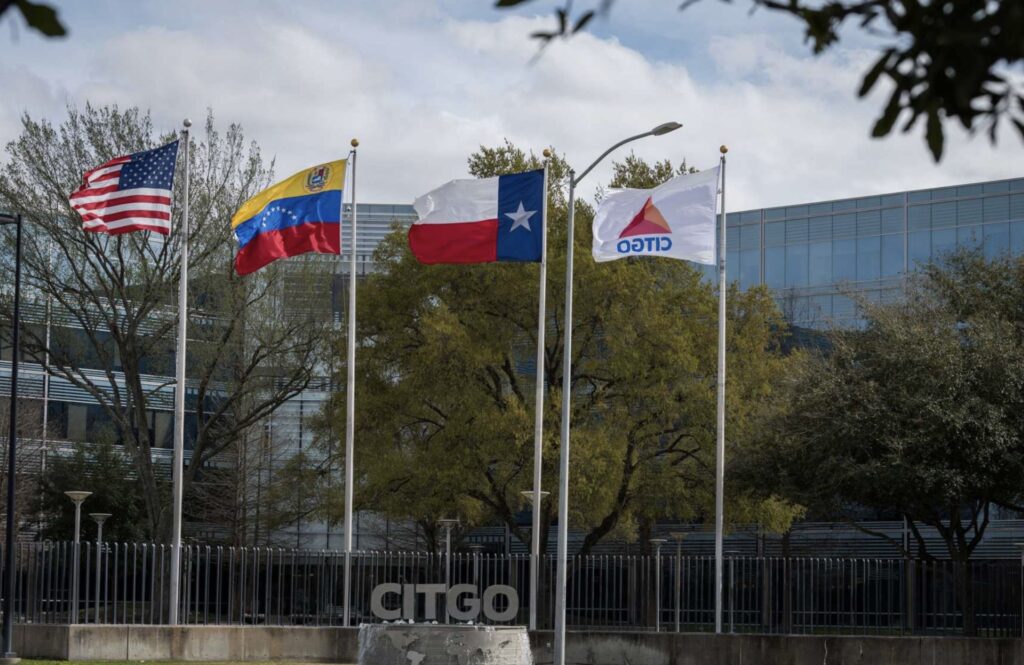
CITGO has returned to PDVSA-aligned governance structures without a reset in fiduciary or institutional frameworks, raising questions around creditor exposure and corporate governance.
A New Sanctions Architecture: GL52 and Controlled Re-entry
The most consequential development this week may be regulatory.
The U.S. Treasury’s issuance of General License 52 (GL52) establishes a structured framework enabling conditional economic engagement with PDVSA—effectively redefining how sanctions operate in practice.
Under GL52:
- Eligible U.S. entities may transact with PDVSA and its subsidiaries
- Contracts must be governed by U.S. law and jurisdiction
- Payments to blocked Venezuelan actors must be routed through Foreign Government Deposit Funds under U.S. Treasury oversight
This creates a controlled financial mechanism:
➡️ Economic activity is permitted
➡️ Revenue flows are partially externalized and monitored
At the same time, GL52 imposes strict guardrails:
- No transactions with most SDN-listed individuals
- Restrictions involving geopolitical actors
- Mandatory reporting on oil transactions, volumes, and payments
The result is a highly engineered sanctions regime—less about isolation, more about managed reintegration.
A Layered U.S. Policy: Protect, Enable, Retain Leverage
GL52 operates within a broader recalibration:
- CITGO asset protections have been renewed, shielding it from creditor enforcement even after PDVSA regained control
- FAQ 1245 confirms licensed engagement pathways with PDVSA
- General License 5 (GL5V) maintains financial channels tied to PDVSA’s 2020 bonds
Together, these measures form a coherent architecture:
- Protect strategic assets (CITGO)
- Enable controlled commercial flows (GL52)
- Preserve financial optionality (GL5V)
Washington is no longer seeking to isolate Venezuela—but to shape its re-entry into global markets while retaining leverage.
Amnesty and Its Limits
Implementation of the Amnesty Law continues, with additional releases reported. While it represents a step toward political de-escalation, concerns remain over selective application and legal consistency as expressed by the U.N. High Commissioner for Human Rights. Nonetheless, the visit of former Spanish Prime Minister José Luis Rodríguez Zapatero to Venezuela’s National Assembly this week added an international dimension to the ongoing amnesty process. Long involved in mediation efforts in Venezuela, Zapatero used his appearance to publicly endorse the implementation of the Amnesty Law as a necessary step toward political de-escalation and national reconciliation. His message emphasized dialogue, coexistence, and the reintegration of political actors as essential components of any sustainable transition.
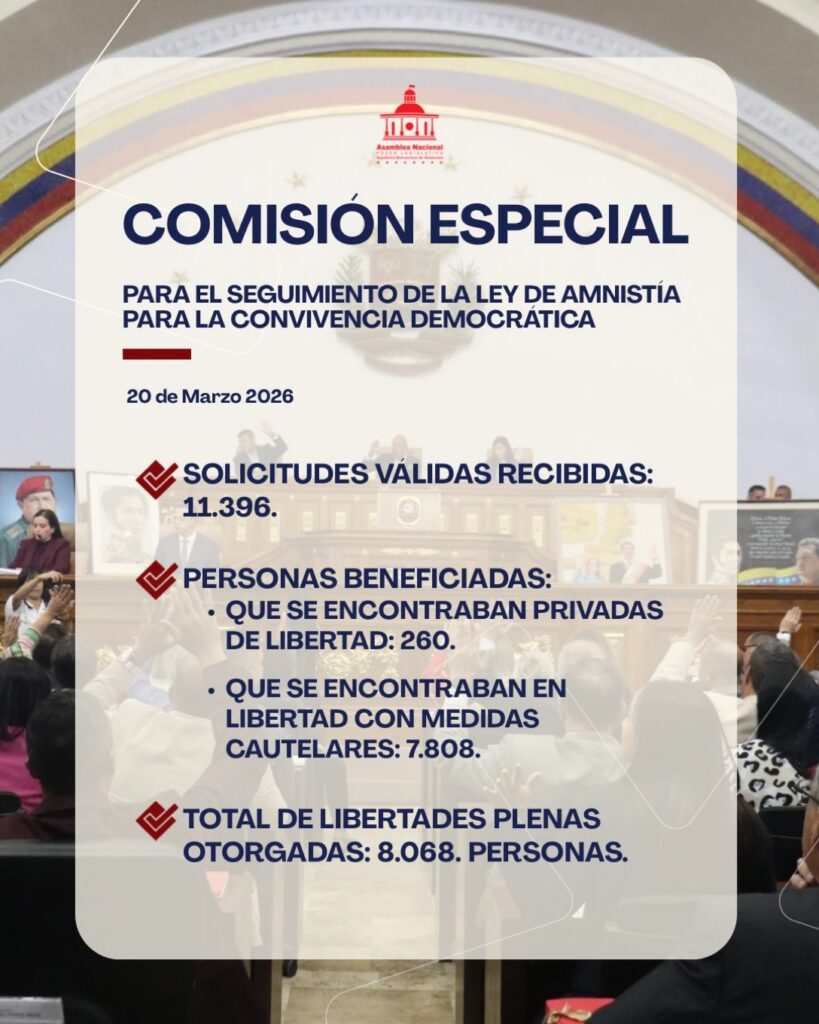
The law is definitely an important and positive step ahead in the delicate process emerging in Venezuela. While there is no comprehensive or transparent accounting of petitions formally denied by Venezuelan courts it is true that a number of amnesty cases have not been granted, and some will move to appeals in order to determine the merits of each case, within a judiciary that has not earned the public trust for lack of independence. However, available evidence suggests that the number of benefits granted under the Amnesty Law significantly outweighs publicly known or reported denials. Official figures indicate more than 8,000 individuals have received full liberties out of 11,000 petitions, of whom 260 where individuals who remained in prison, while documented cases of rejection or exclusion have emerged through press reports and social media. This imbalance points to substantial forward movement in the law’s implementation, even as the absence of systematic disclosure on denied petitions continues to raise concerns about transparency, consistency, and due process in the overall application of the measure. On the other hand, there are close to 500 individuals imprisoned, who qualify as poltical prisoners according to reputable human rights organizations such as PROVEA and Foro Penal. This is pending a resolution beyond amnesty through special measures such as case dismissals or Presidential pardons.
Capitol Hill engages—Cautiously
A visit by staff from the U.S. Senate Foreign Relations Committee (STAFFDEL) suggests groundwork for a bipartisan congressional delegation (CODEL).
Should Congress reassert a role, it could reintroduce electoral conditionality and institutional benchmarks into a policy framework currently dominated by executive pragmatism.
Extractive Recovery
Economic activity remains concentrated in extractive sectors.
Advances involving Minerven and firms such as Trafigura reinforce a recovery model driven by resource exports and external capital inflows, with limited impact on living standards.
The risk is a two-speed economy: macro stabilisation without social recovery.
Sovereignty and the Diaspora Voice
Amid these developments, Venezuela’s victory over the United States in the World Baseball Classic briefly unified the country—before intersecting with geopolitical narratives when President Trump reacted by proposing Statehood for Venezuela in an innuendo blended with humor.
In response, Venezuelan-American leader Leopoldo Martínez stated in his X account:
”Venezuela values a strong and respectful partnership with the United States—but never at the expense of national dignity or self-determination.”
An Emerging Equilibrium
The pattern is now clear:
- Political control and consolidation around President Delcy Rodriguez is tightening
- Economic engagement is expanding selectively
- External actors, and evidently the Trump administration, are prioritising stability and key corporate interest in the economic front.
Closing
Venezuela is no longer isolated. But neither is it transforming to the full extent of expectations of the country’s democratic alternative, the international comunity, and the diaspora.
Instead, it is consolidating a phase where economic changes to stabilize the country and political continuity coexist—a balance that may prove durable, but ultimately fragile without further institutional change and an credible and reasonable electoral timetable.