

Venezuela faces a transition conditioned—or even shaped—by the United States government with the ruling establishment.
I have long opposed economic sanctions—whether broad-based or sectoral, such as those imposed by the United States in the Venezuelan case—despite being a firm opponent of the authoritarianism that took hold in the country. Not out of naïveté about power, but from a reading of history: such measures rarely displace ruling elites, yet they often inflict severe harm on societies.
That is precisely what happened, albeit with nuances. Power adapted; it did not fall. The country did.
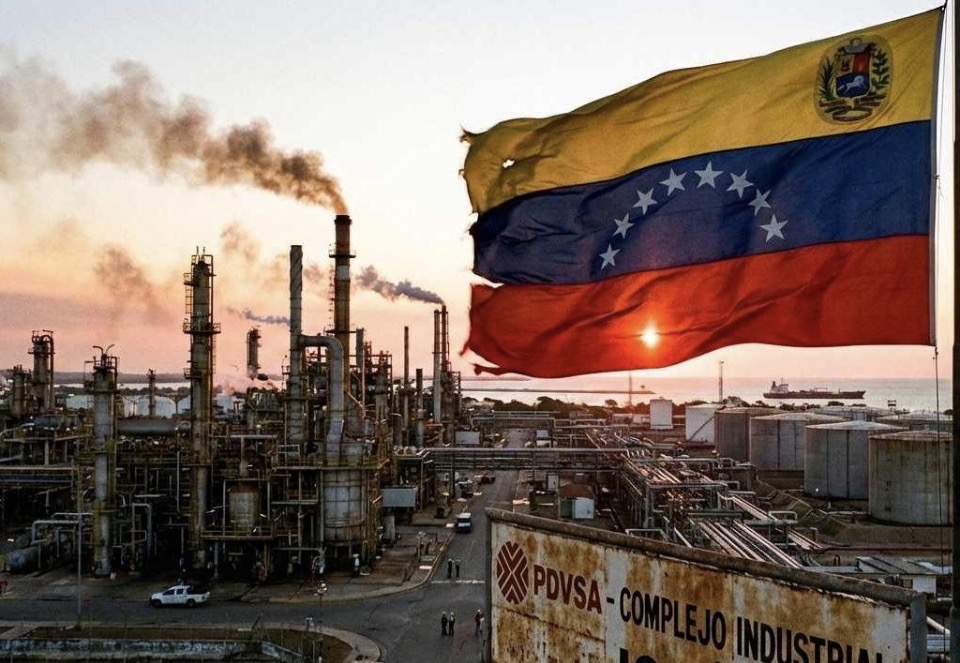
The ruling elite withstood economic sanctions and ultimately preserved itself, even under conditions of maximum external pressure and after the events of January 3, 2026. Today, with Nicolás Maduro no longer at the helm, a caretaker arrangement remains in place—sustained both by recognition from the United States, particularly under Donald Trump, and by a controversial interpretation by the Constitutional Chamber of the Supreme Court regarding presidential absences, classifying the situation as forced or indeterminate and thereby avoiding the constitutional mechanisms that would require elections in the event of a definitive vacancy. At the same time, sanctions accelerated the collapse of an economy already deeply weakened by corruption and senseless economic policies, reducing oil revenues and deepening the crisis.
The outcome of this entire trajectory has been devastating: an economic contraction without precedent in peacetime, widespread impoverishment, and mass migration. Among the starkest figures reported this week—by acting president Delcy Rodríguez herself—is that Venezuela now has more pensioners than contributors to its social security system, reflecting a profoundly distorted labor structure in a country from which more than eight million people have emigrated. At the same time, remittances have acquired structural importance: not only have they reached historically high levels, but they have also become one of the country’s main sources of foreign currency, at times rivaling traditional sectors such as oil. All of this has occurred in a context where oil revenues had already declined and where discounts were applied to place crude in international markets—primarily China—under the sanctions regime, culminating in the troubling reality that oil now sold at market prices through U.S.-authorized channels is held in Treasury-controlled accounts, beyond the free disposal of Venezuela’s caretaker government, precisely as a consequence of the deeply damaging reputation accumulated by those responsible for governing the country in the run-up to a possible transition.
Yet that debate, while necessary, is no longer sufficient.
The challenge now is not to explain failure, but to confront reality. And that reality—complex and uncomfortable—points to a transition that is not the result of rupture, but of a conditioned political reconfiguration, with a decisive role played by the United States and with the ruling establishment inheriting Chavismo as the central actor.
This fact cannot be ignored. It must be managed. It is difficult to deny that much of what is unfolding—or is actively being shaped—stems from prior understandings with the United States. That framework conditions the process and defines its limits.
Herein lies the principal risk.
A transition defined without broad internal consensus is unlikely to endure or to produce a legitimate and sustainable government. More importantly, we cannot afford another failure. The country—and its people—deserve more from their leadership.
But there is a second risk.
Nor can Venezuela’s future be built on a web of licenses—granted at the sole discretion of the U.S. government to select private interests—that effectively conditions sovereignty to energy, mining, or corporate actors. In many cases, these arrangements take the form of so-called national interest agreements whose terms remain undisclosed and which have not been duly authorized by the National Assembly, as required by the Constitution, regardless of recent legislative reforms that may have enabled such frameworks. Every agreement of national interest—particularly in hydrocarbons and mining—must be transparent and approved by the legislative branch. These investments may be necessary, even urgent. But they cannot substitute for a sovereign political determination of the country’s future.
Venezuela must build a legitimate transition—one that leads to a democratic society, not a new form of dependency.
This is why a national agreement is urgent—one that includes not only those currently in power, but also those who represent the democratic alternative, along with civil society and the private sector. Only then can Venezuela begin to restore what matters most: sovereignty, which resides with its people.
Such an agreement requires two decisions.
First, to engage in a serious dialogue—without naïveté—grounded in verifiable guarantees that can build trust in what will inevitably be a fragile process.
Second, to articulate a unified national position to promote the gradual lifting of sanctions, tied to concrete progress in institutional reconstruction: judicial independence, a credible electoral system, strengthened oversight institutions, central bank autonomy, and a clear and agreed electoral roadmap. This task cannot remain at the level of generalities. It requires defining who will lead this institutional rebuilding, entrusting that responsibility within the framework of the agreement, and ensuring that those who assume it are not subjected to political vilification precisely for embodying that consensus.
Without incentives, reforms will not happen. But without reforms, any relief will lack legitimacy.
Venezuela cannot remain trapped between two failures: that of an authoritarianism that destroyed institutions and the economy, and that of an international strategy which, in attempting to force its collapse, ultimately deepened the country’s socio-economic breakdown and opened the door to a new form of tutelage—ironically in a nation historically defined by its strong sense of sovereignty and its capacity to build prosperity on that foundation in earlier critical periods over the past decades.
The transition now unfolding is imperfect, conditioned, and even uncomfortable. But it is also an opportunity.
Seizing it will require realism, clarity, and above all a collective willingness to put the country above all else.
After years of sterile confrontation, the question is no longer who was right.
The question is whether we are finally ready to rebuild Venezuela.
*Leopoldo Martínez Nucete is an international lawyer and former Venezuelan congressman. He is the founder of the Center for Democracy and Development in the Americas (CDDA) and served as Senior Counselor at the U.S. Department of Commerce during the Joe Biden administration.