

Venezuela Weekly Briefing
By IQLatino DC/Caracas Desk
Venezuela’s opening moved from signals to execution this week. Five developments framed the moment: new oil and gas agreements with major European companies, the return of direct commercial flights between the United States and Caracas, renewed attention to expected changes in the Supreme Court after magistrate retirements, polling that shows both public demand for economic relief and persistent institutional distrust, and a new income announcement designed to respond to growing social pressure.

The result is a sharper picture of Venezuela’s current transition. This is not yet a democratic opening in the full sense. It is a managed economic opening, shaped by external interest in energy, infrastructure and financial normalization, and by internal pressure from a population that wants salaries, electricity, lower inflation and a more livable daily economy.
The question is whether this economic opening can produce enough relief to stabilize the country while also creating space for institutional reform — or whether it will simply strengthen a governing coalition that remains deeply unpopular and politically distrusted.
Energy deals lead the week
The clearest movement came in oil and gas. BP signed a memorandum of understanding with Venezuela to develop the Cocuina-Manakin offshore gas field and explore opportunities in the Loran gas area. The agreement is significant because Cocuina-Manakin straddles the maritime border between Venezuela and Trinidad and Tobago, making Trinidad’s LNG infrastructure central to any serious development plan. BP already has a major position on the Trinidad side, which gives the project a clearer commercial logic than many other Venezuelan energy prospects.
The deal also has political weight. For Caracas, BP’s return is a signal that major international companies are again willing to engage directly with the Venezuelan state. For BP, the project offers access to offshore gas reserves that could eventually feed LNG exports. For the region, it strengthens the idea that Venezuelan gas — rather than crude — may become the most practical first phase of the country’s energy reinsertion.
Eni also signed an agreement with Venezuela’s oil ministry and PDVSA to relaunch a heavy crude project in the Orinoco Belt, particularly around Junín 5. Unlike the BP deal, this is a crude-oil play, tied to Venezuela’s largest hydrocarbon base. It places Eni among the foreign operators positioning themselves as the government reviews contracts and seeks to rebuild production capacity after years of sanctions, underinvestment and operational decay.
Separately, the Eni-Repsol joint venture at Cardón IV said it is seeking to raise gas production from roughly 580 million cubic feet per day to about 645 million cubic feet per day. This appears more like an operational ramp-up than a newly signed agreement, but it belongs to the same pattern: companies are no longer merely preserving assets; they are beginning to plan incremental expansion.
A further signal came from the domestic gas industry’s own projections. Luis Alberto Terrero, president of the Venezuelan Association of Gas Processors, said Venezuela’s natural gas production could increase by 134% over ten years, from roughly 4.7 billion cubic feet per day today to 11 billion cubic feet per day. According to that projection, the largest contribution would come from new offshore licenses, while the second-largest increment — around 1.2 billion cubic feet per day — would come from the Carito Pirital project, tied to an agreement between Shell and the Venezuelan engineering firm Vepica.
The Shell-Vepica reference is important because it broadens the week’s energy story beyond BP, Eni and Repsol. It suggests that Venezuela’s gas recovery strategy is being imagined as a multi-project platform: offshore licenses, legacy fields, compression plants, Maracaibo recovery and private-sector participation across the chain. It also reinforces the central theme of the week: gas is emerging as the most credible first chapter of Venezuela’s energy reinsertion, especially where projects can connect to infrastructure, replace liquid fuels in power generation and attract private capital.
The energy takeaway is clear: Venezuela is again being treated as investable, but still under a high-risk, politically conditioned framework. These agreements are not yet proof of a full recovery. They are proof that foreign operators and domestic industry actors are positioning early for a new cycle.
Direct U.S.-Venezuela flights return
The second major signal came in aviation. Direct commercial passenger service between the United States and Venezuela resumed after seven years, with the first American Airlines flight from Miami landing in Caracas on Thursday. American plans daily flights and expects to add a second daily service beginning May 21.
This matters beyond travel logistics. For years, Venezuela’s isolation was visible in the disappearance of ordinary air routes. Flights became limited, expensive and circuitous, reinforcing the country’s disconnection from business, diplomacy, tourism, family travel and the diaspora. The return of direct flights changes the practical conditions of engagement.
It also carries political symbolism. Air connectivity signals that Venezuela is becoming reachable again. It facilitates business travel, consular engagement, technical visits, family reunification and humanitarian mobility. In the context of the week’s energy agreements, the timing is important: companies cannot scale projects, bring personnel, supervise assets or rebuild commercial relationships without reliable connectivity.
The flight reopening does not normalize Venezuela by itself. But it is part of the infrastructure of normalization. A country cut off from flights, banks, credit markets, multilateral channels and investment flows is harder to reform and easier for entrenched elites to control. Reconnection, if conditioned and monitored, can begin to change that equation.
Supreme Court changes: a test for a national transitional agreement
The domestic institutional track also moved this week, with attention turning to the expected changes in Venezuela’s Supreme Court following the retirement of a significant group of magistrates. The process could lead to one of the most consequential judicial reshuffles in recent years, precisely as the government tries to project a broader agenda of normalization and institutional repair.
That is why the concerns raised by Gerardo Blyde, former chief negotiator for the Venezuelan opposition in the Norway-facilitated process and the Barbados Agreement, and echoed by Leopoldo Martínez Nucete, former Venezuelan Congressman and Senior Counselor at the U.S. Department of Commerce during the Biden administration, are important. The issue is not merely whether new magistrates are appointed, or whether the Court is partially renewed. The real question is whether this moment is framed within a broader national transitional agreement that gives the country credible rules for institutional reconstruction, political guarantees, legal certainty and eventual electoral normalization.
A Supreme Court reshuffle outside such a framework could become a lost opportunity with durable consequences. Venezuela’s high court has been one of the central instruments of institutional breakdown: validating executive overreach, weakening checks and balances, limiting political pluralism, and providing legal cover for decisions that reshaped the country’s constitutional order. Replacing names without changing the logic of control would not restore confidence. It would merely refresh the façade.
For the current opening to gain credibility, the Court process should not be treated as an internal administrative adjustment. It should be part of a negotiated transition architecture that includes transparent nomination criteria, professional qualifications, consultation beyond the governing coalition, guarantees for political actors, and a credible commitment that the new Court will not simply reproduce the discipline of the outgoing one.
This matters because the week’s economic signals — energy agreements, restored flights and renewed international engagement — all require a legal system capable of supporting contracts, resolving disputes, protecting rights and creating confidence. But the stakes are larger than investment. A politicized Court would also shape the rules of any future electoral process, transitional justice arrangement, institutional reform and peaceful transfer of power.
The Supreme Court renewal is therefore an early and defining test of whether Venezuela’s managed economic opening can be connected to a genuine political horizon. If handled narrowly, it may consolidate the same institutional order under new names. If handled as part of a national transitional agreement, it could become one of the first concrete steps toward rebuilding the legal foundations of a sustainable transition.
Polling: economic urgency, institutional distrust
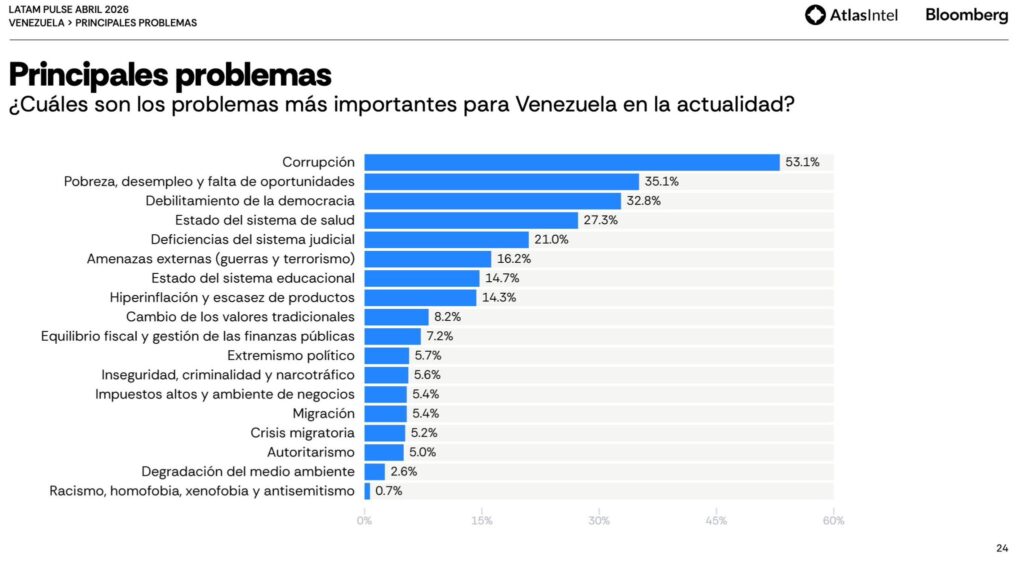
The public-opinion picture helps explain both the opportunity and the risk. The latest AtlasIntel/Bloomberg poll shows Venezuelans identifying corruption as the country’s leading problem, followed by poverty, unemployment, lack of opportunity, weakening of democracy, deterioration of the health system and judicial deficiencies.
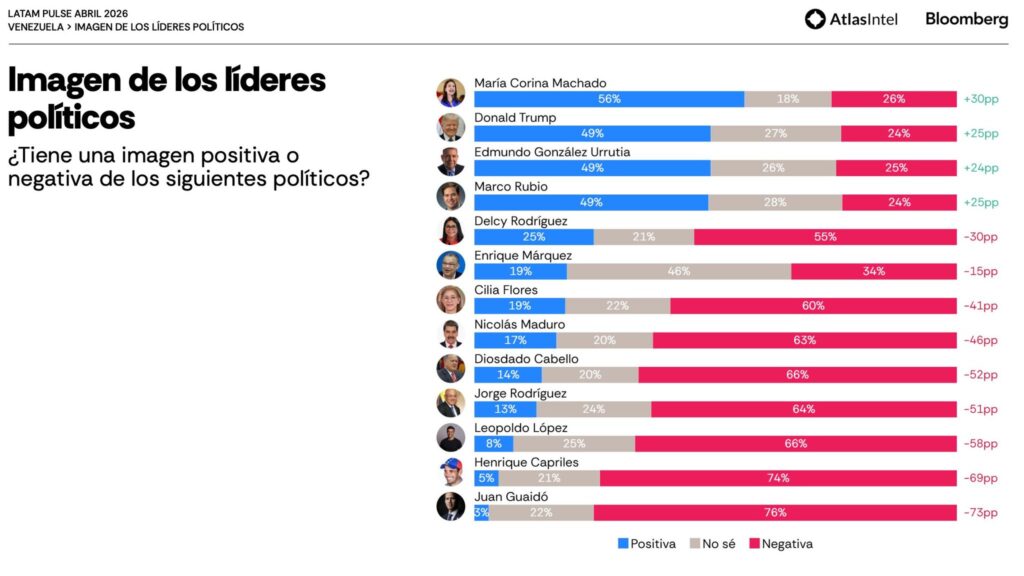
The same polling shows that, on the opposition side, María Corina Machado and Edmundo González Urrutia remain the strongest figures in public perception. Machado leads the field with 56% positive and 26% negative, while González Urrutia registers 49% positive and 25% negative. A notable emerging figure is Enrique Márquez, who reaches 19% positive and 34% negative, with a large 46% “don’t know” share — suggesting room for growth, but also limited national definition.
By contrast, the rest of the opposition figures measured fall dramatically behind: Leopoldo López registers 8% positive and 66% negative, Henrique Capriles 5% positive and 74% negative, and Juan Guaidó 3% positive and 76% negative. Strikingly, these figures are now behind even most leading Chavista officials in positive image.
On the government side, Delcy Rodríguez appears as the least damaged public face of the governing coalition, with 25% positive and 55% negative, ahead of Nicolás Maduro at 17% positive and 63% negative, Diosdado Cabello at 14% positive and 66% negative, Jorge Rodríguez at 13% positive and 64% negative, and Cilia Flores at 19% positive and 60% negative. But the AtlasIntel/Bloomberg numbers still show a governing coalition with deeply negative image balances.
Datanálisis, as summarized by Luis Vicente León, captures another layer of the same mood: 55% of Venezuelans identify inflation and low wages as their main problem, followed by devaluation, electricity failures and other economic concerns. The same survey found that 65% of the population agrees that Venezuela’s priority should be resolving the economic crisis before deepening the debate over political transformation.
These findings are not contradictory. They point to two levels of Venezuelan public opinion. Atlas captures the structural diagnosis: Venezuelans know that corruption, democratic erosion and institutional collapse are at the root of the crisis. Datanálisis captures the household urgency: salaries, prices, devaluation, electricity and purchasing power come first.
That distinction is essential for understanding the current opening. Venezuelans may diagnose the country’s illness politically, but they experience the pain economically. They want relief now. That gives the economic opening political relevance. Energy deals, flights, financial normalization and investment can align with public priorities if they translate into visible improvements in daily life.
At the same time, the leadership numbers show that economic normalization has not erased Venezuela’s political legitimacy gap. María Corina Machado and Edmundo González remain the dominant opposition references, Enrique Márquez appears as a modest but noteworthy emerging figure, and the older opposition leadership — López, Capriles and Guaidó — remains severely weakened. On the government side, Delcy Rodríguez may lead the governing coalition’s public-image ranking, but she does so from a strongly negative position.
But Luis Vicente León’s warning about the “expectations gap” is central. The time of investors and the state is slow: licenses, contracts, infrastructure, financing, risk committees and operational recovery take months or years. The time of citizens is immediate: prices, salaries, exchange rates and electricity failures are felt every day. If the public sees international companies returning and flights resuming, but does not see purchasing power improve, expectations can turn quickly into frustration.
That is why the salary and bonus question has become more than a labor issue. It is a political test of whether the emerging stabilization process can generate a minimum social dividend. If the government’s announcements fall short of expectations, the gap between macro-normalization and household reality could widen. If they are more substantial, they may buy time — but only temporarily, unless accompanied by broader economic and institutional reforms.
Wage increase: the first test of the expectations gap
That pressure became concrete this week when Delcy Rodríguez announced an increase in Venezuela’s comprehensive minimum income to $240, up from $190. Pensioners’ income will rise from $60 to $70. The government described it as the most significant increase in recent years and said the adjustment followed an agreement among the government, unions and the business sector.
The announcement is politically important, but also revealing. It does not appear to resolve the deeper labor question: whether the formal base minimum wage — frozen since 2022 at Bs. 130, worth only a few cents at the official rate — will actually be adjusted. That distinction matters because bonuses and vouchers improve immediate income but generally do not carry the same implications for pensions, severance, vacation pay, profit-sharing and broader labor rights. On the other hand, it must be noted that the “canasta alimentaria” which includes the basic needs of a household in Venezuela amounts to $645 per month.
In that sense, the increase confirms the core argument of this week’s polling. The government understands that economic normalization must quickly produce visible relief. Energy deals, flights and international re-engagement may improve the macro narrative, but Venezuelans will judge the opening by what happens to salaries, pensions, prices, electricity and purchasing power. The new $240 income floor may buy some time, but it also raises the benchmark against which the population will measure the next phase of stabilization.
The risk is that this becomes a short-term containment mechanism rather than the beginning of a durable income recovery strategy. If the increase is not supported by productivity gains, exchange-rate stability, fiscal discipline and a credible framework for private-sector expansion, it could either fall behind inflation or intensify pressure for repeated adjustments. If it is linked to a broader stabilization program, however, it could become the first visible social dividend of the opening.
For that reason, the wage announcement should be read alongside the energy deals, restored flights, Supreme Court renewal and polling data. This week was not only about Venezuela reopening to companies and international actors. It was also about the government trying to answer a more immediate domestic question: whether the emerging economic opening can reach citizens’ pockets before public optimism turns into frustration.
The week’s political meaning
This week’s developments should be read together. The energy deals show foreign companies positioning for a new cycle. The return of U.S.-Venezuela flights shows the infrastructure of reconnection being rebuilt. The Supreme Court reshuffle shows that institutional reform is now unavoidable, but still uncertain. The polls show that Venezuelans want economic relief first, while continuing to distrust the political and institutional system that produced the crisis. The income announcement shows the government understands that the expectations gap is no longer theoretical.
The emerging formula is not “economy instead of politics.” It is economy first, but not economy alone. A managed economic opening can buy time, reduce isolation and create incentives for cooperation. But it cannot substitute for judicial reform, anti-corruption measures, political guarantees and a credible electoral horizon.
For Washington, regional governments and investors, the task is to shape the opening rather than romanticize it or reject it outright. Energy, aviation and financial normalization can support stabilization. But they should be tied to measurable institutional steps: credible judicial appointments, a transparent Supreme Court renewal process, political guarantees, electoral conditions, and transparency in public assets and contracts.
Venezuela’s opening is gathering pace. Expectations are rising with it. The test now is whether this week’s economic momentum becomes the bridge to institutional reconstruction — or merely the next mechanism by which power adapts, survives and postpones real political change.