

By IQ Latino DC/Caracas Desk
Movimiento por Venezuela (MPV) is a Venezuelan opposition party with a progressive and institutional profile, led nationally by economist and former National Assembly deputy José Simón Calzadilla. The party has been part of Venezuela’s democratic opposition coalitions, including the 2015 parliamentary victory that gave the opposition control of the National Assembly, and it has remained engaged in the difficult debate over how to combine electoral participation, institutional pressure, negotiation, and democratic guarantees under authoritarian conditions.
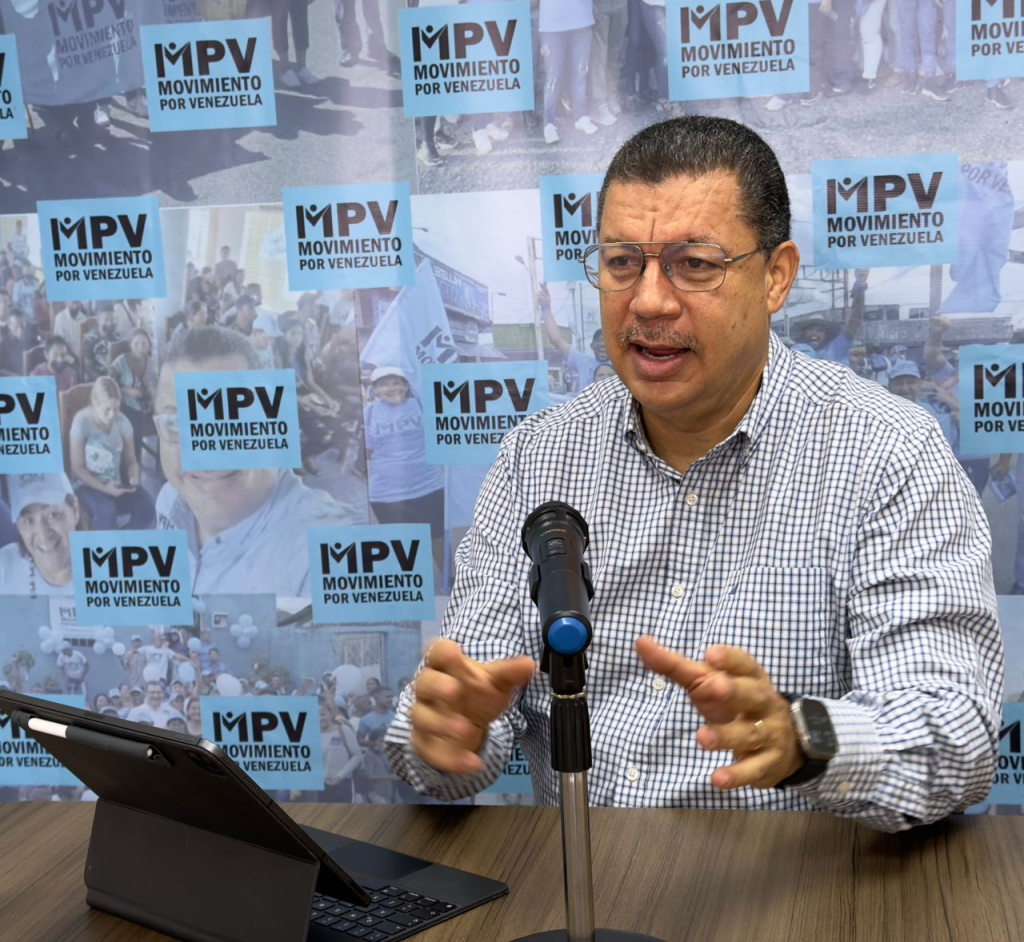
MPV’s political relevance lies less in its electoral size than in its role as part of the opposition’s institutional and negotiation-oriented current. It has consistently argued that Venezuela’s crisis cannot be resolved by a symbolic election alone, nor by an open-ended arrangement without democratic closure. Its latest proposal, signed by Calzadilla and dated January 26, 2026, reflects that orientation: a call for a broad national agreement to organize a transition that restores constitutional order, rebuilds democratic institutions, stabilizes the economy, advances national reconciliation, and culminates in credible elections.
The document places negotiation—not unilateral rupture—at the center of Venezuela’s democratic reconstruction. It argues that the path forward requires an agreement among the democratic opposition, civil society, and the current authorities, with mediation from Venezuela’s “principal international ally.”
A transition anchored in Article 333
The first point of MPV’s proposal is its strategic objective: restoring the effective validity of the Venezuelan Constitution. The document explicitly invokes Article 333, which provides a constitutional basis for recovering democratic order when constitutional rule has been disrupted. MPV defines the “transition period” as the phase between the overcoming of the current political regime and the establishment of a political system where popular sovereignty is fully respected through suffrage.
This framing is politically significant. Rather than treating transition as an improvised power-sharing arrangement or merely as an electoral calendar, MPV presents it as a constitutional process. Its endpoint is not simply a change in government, but the reconstruction of a system where institutions, elections, and civil liberties operate under constitutional legitimacy.
Liberalization first: political opening and economic stabilization
The second point is an immediate process of political liberalization and economic stabilization. MPV calls for the release of political prisoners with full rights, the free activity of persecuted political leaders inside and outside the country, the restoration of political participation rights for citizens and parties, and full freedom of expression. The proposal also calls for the repeal of the Decree of External Commotion, which MPV describes as a measure that restricts fundamental constitutional guarantees.
On the economic front, the document proposes dismantling exchange controls, restoring the autonomy of the Central Bank of Venezuela, fully implementing transparency rules in public administration, and restructuring the Comptroller General’s Office so it can recover its oversight function.
The political logic is clear: before Venezuela can move credibly toward elections, the country needs visible and verifiable signals that it has entered a serious process of change. Liberalization and stabilization are presented not as separate tracks, but as mutually reinforcing conditions for a successful transition.
Rebuilding institutions before restoring electoral sovereignty
The third point is progressive democratization through institutional restructuring. MPV specifically identifies the National Electoral Council, the Supreme Court, and the Citizen Power institutions as bodies requiring restructuring and balance. To achieve this, the proposal suggests creating a plural political space dedicated to institutional appointments.
This is one of the proposal’s most relevant contributions. It implicitly recognizes that Venezuela’s crisis is not only electoral but institutional. An election held under unchanged institutional conditions risks reproducing distrust, conflict, and contested results. MPV therefore argues that credible democratization requires rebuilding the institutions that administer elections, interpret the law, and oversee public power.
The document also calls for substantial changes within the National Executive that can generate confidence across society, including among those who currently hold power, the democratic opposition, and the wider citizenry. The objective is to sustain political and social stability throughout the transition.
Reconciliation, guarantees, and transitional justice
The fourth point is national reconciliation. MPV proposes security guarantees for all political actors and identifies instruments such as amnesty, immunity, and truth commissions as tools that could support a negotiated democratic opening. It also calls for the involvement of the international community and multilateral organizations to provide greater support, credibility, and security to the agreements reached.
This section reflects one of the hardest realities of any negotiated transition: those who hold power must believe that change does not mean immediate existential threat, while victims and citizens must see that reconciliation does not become impunity. The proposal does not fully resolve that tension, but it places the issue where it belongs—at the center of the transition architecture.
Social recovery and an electoral timetable
The fifth point links the restoration of political, economic, and social rights with a concrete economic and social recovery agenda. MPV calls for a timetable of policies aimed at improving citizens’ welfare while, through political agreements, defining an electoral calendar that restores sovereignty to the people through suffrage.
This is an important distinction. The proposal does not reject elections; it situates them as the culmination of a transition process rather than its starting point. The election becomes the mechanism through which the transition closes and a new period of stability, development, dignity, and prosperity begins.
IQ Latino analysis: a conditions-first transition framework
The essence of MPV’s proposal is a conditions-first transition framework. Its argument is that Venezuela needs a negotiated transition with a defined endpoint, but that endpoint must be supported by prior guarantees: political rights, institutional restructuring, economic stabilization, reconciliation mechanisms, and international accompaniment.
That approach aligns with a growing recognition among Venezuelan political actors and international stakeholders: an electoral date without enforceable conditions may not solve the crisis. Conversely, an open-ended transition without a timetable could become another mechanism for indefinite control. MPV attempts to bridge those risks by calling for both a defined transition period and a negotiated electoral calendar.
The proposal’s strength lies in its realism. It accepts that the current authorities must be part of the negotiation, that the opposition alone cannot impose institutional change, and that civil society and international actors must help secure the process. Its vulnerability lies in the same place: the success of such a roadmap depends on whether the parties can agree on sequencing, guarantees, enforcement mechanisms, and the role of external mediators.
For Washington and other international actors, the proposal offers a practical policy lens: the priority should not be to rush Venezuela into another contested electoral event, but to help accelerate the conditions that would make a future election meaningful. That means linking diplomatic engagement, sanctions relief, institutional reform, economic stabilization, and electoral guarantees into a coherent transition architecture.
Conclusion
Movimiento por Venezuela’s proposal adds an important voice to the debate over Venezuela’s future. It argues that the country needs neither a rushed election without conditions nor an indefinite political arrangement without democratic closure. Instead, it calls for a negotiated transition anchored in the Constitution, supported by institutional reform, accompanied by economic stabilization, framed by reconciliation guarantees, and concluded through a credible electoral process.
Its closing message—“With a united Venezuela, we all win”—captures the political aspiration behind the document. The challenge is whether Venezuela’s fragmented political system, its entrenched governing coalition, and its international stakeholders can turn that aspiration into a workable transition agreement.