

Transforming Wasted Energy into the Strategic Infrastructure of the 21st Century
Some ideas transcend generations without losing their relevance. “Sow the oil,” Arturo Uslar Pietri’s famous call to action in 1936 Venezuela, remains one of them. For decades, the Venezuelans have debated how to transform its energy wealth into a more diversified, productive, and sustainable economy. Today, amid the digital revolution, that aspiration takes on an unexpected new form: transforming the natural gas that is routinely flared in oil fields into the energy that powers data centers, artificial intelligence, and digital services.
This reflection also stems from my experience in Northern Virginia here in the United States, which over the past two decades has become the largest concentration of data centers in the world. As a political leader and public policy advisor in Virginia, I had the opportunity to observe firsthand how a combination of strategic vision, regulatory stability, infrastructure investment, and collaboration between the public and private sectors transformed a competitive advantage into a globally significant technology ecosystem. Virginia’s experience demonstrates that participation in the digital economy is not the product of chance; it is the result of deliberate and sustained policy choices. That lesson is particularly relevant for Venezuela, a country blessed with exceptional energy resources and a unique opportunity to position itself within the industries of the future.
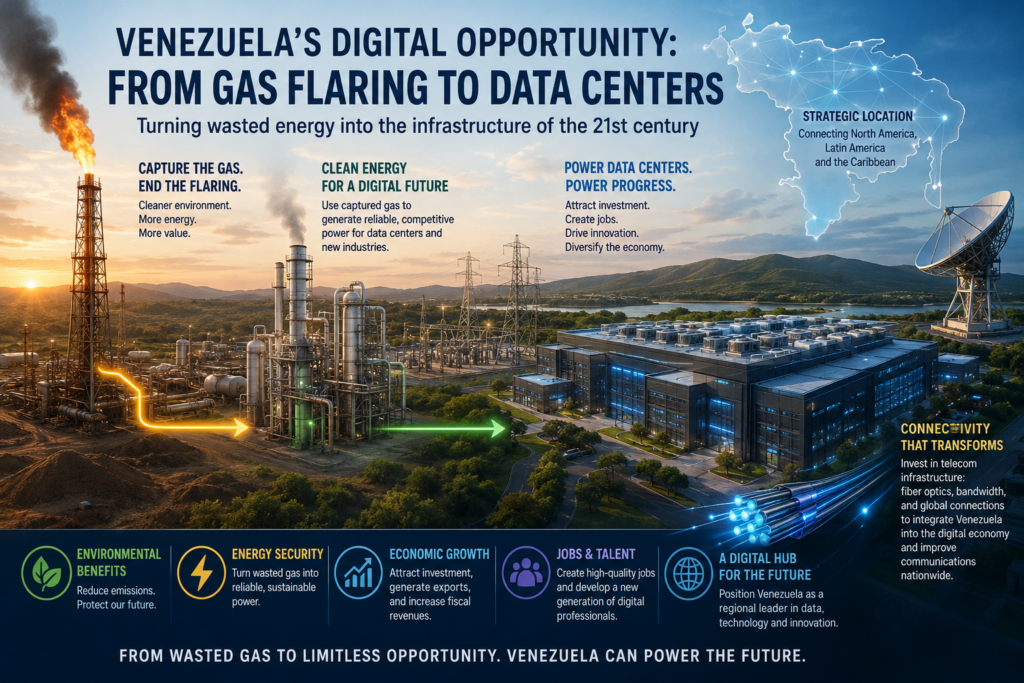
This article explores a strategic opportunity for Venezuela: leveraging the natural gas currently wasted through routine flaring to support a new industry centered on data centers, digital services, and artificial intelligence. The proposal seeks to transform an environmental liability into a source of economic growth, investment, and technological modernization by aligning Venezuela’s energy resources with the demands of the global digital economy.
The idea may seem ambitious, but its economic logic is increasingly difficult to ignore. Digital infrastructure depends on abundant, reliable, and competitively priced energy. Wherever that combination exists, opportunities emerge to attract investment in cloud computing, artificial intelligence, and advanced data processing. Venezuela possesses a resource that it currently wastes and that could become a powerful competitive advantage.
The rapid growth of artificial intelligence and digital services is driving unprecedented investment in technology infrastructure. Companies such as Microsoft, Amazon Web Services, Google, and Oracle are actively seeking locations capable of supplying the enormous amounts of electricity required to operate hyperscale data centers and AI computing facilities. Few countries combine significant volumes of wasted natural gas, vast expanses of available land, and a geostrategic location connecting North America, Latin America, and the Caribbean as Venezuela does.
If we can convert wasted energy into digital processing capacity, we can transform an environmental burden into a catalyst for investment, exports, innovation, and economic diversification.
Today, Venezuela ranks among the world’s leading gas-flaring nations. According to World Bank estimates, the country flares between 8 and 10 billion cubic meters of natural gas annually—enough energy to support an entirely new industrial sector. Capturing even a portion of this associated gas and converting it into electricity could generate between 1,500 and 2,500 megawatts of continuous power, depending on plant efficiency and operating conditions. That amount of generation could support multiple hyperscale data center campuses dedicated to cloud computing, data storage, and artificial intelligence.
Rather than allowing this resource to go up in smoke, Venezuela should launch a national effort to capture, process, and monetize associated gas, directing part of it toward dedicated power generation for digital infrastructure.
The opportunity is particularly compelling because data centers have become the backbone of modern economic activity. They support artificial intelligence, cloud computing, telecommunications, financial systems, e-commerce, and countless digital services. The International Energy Agency projects that global data center electricity demand could more than double by 2030. The energy that Venezuela currently wastes through flaring could instead generate jobs, exports, tax revenues, and economic growth.
The availability of competitive energy opens the door to a second opportunity: attracting investment in large-scale digital infrastructure. Data centers have become strategic assets because they host the cloud platforms, AI systems, and digital services increasingly essential to businesses, governments, and consumers worldwide.
This strategy would also put vast underutilized land resources to productive use. Regions such as Monagas, Anzoátegui, and Bolívar could host technology parks, digital corridors, and energy hubs capable of attracting both domestic and international investment.
International precedents are instructive. Northern Virginia became the world’s largest data center market through a combination of reliable energy, robust connectivity, and regulatory stability. Ireland transformed itself into one of Europe’s leading digital gateways through investment-friendly policies and world-class telecommunications infrastructure. More recently, the United Arab Emirates and Saudi Arabia have committed billions of dollars to position themselves as regional centers for artificial intelligence, cloud computing, and digital services.
Although data centers generate relatively limited direct employment once operational, they stimulate substantial economic activity throughout their development and construction phases. Engineers, telecommunications specialists, construction firms, electrical contractors, and technology service providers all become part of the ecosystem that develops around these investments. More importantly, they create environments that foster innovation, entrepreneurship, and knowledge-based industries.
Yet energy alone is not enough.
If Venezuela hopes to become a meaningful participant in the digital economy, it must modernize its telecommunications infrastructure. Data centers require high-capacity, reliable connectivity. National fiber-optic networks, internet exchange points, international submarine cable connections, and resilient telecommunications systems are as essential to the digital economy as highways, ports, and airports are to traditional commerce.
The encouraging news is that these objectives reinforce one another. Investments in data centers would create powerful incentives to expand and modernize Venezuela’s telecommunications infrastructure. Greater fiber-optic capacity, enhanced bandwidth, improved network redundancy, and stronger international connectivity would benefit not only technology companies but also universities, hospitals, schools, businesses, and citizens across the country.
The infrastructure required to connect Venezuela to the global digital economy would also help connect Venezuelans to one another.
The convergence of energy, digital infrastructure, and telecommunications requires a coherent national development strategy. To translate this opportunity into reality, Venezuela should pursue three sequential and complementary priorities.
First, convert flared gas into productive energy through a national program focused on gas capture, processing, and power generation. The objective is to transform an environmental liability into a reliable source of electricity for new industrial and digital developments.
Second, create the conditions necessary for investment through a transparent framework for public-private partnerships and a comprehensive modernization of the telecommunications sector. This includes expanding fiber-optic networks, strengthening international connectivity, and providing stable rules that reduce risk and attract both domestic and foreign capital.
Third, develop digital infrastructure hubs through targeted incentives for data centers, cloud computing facilities, and artificial intelligence campuses. The goal should be to attract anchor investments capable of generating economic activity, driving innovation, diversifying exports, and positioning Venezuela as a regional node in the digital economy.
There is an additional strategic advantage. Gas-capture and power-generation projects can be developed independently of Venezuela’s national electrical grid, supplying energy directly to industrial parks, data centers, and new economic developments. This approach would allow Venezuela to attract investment without increasing pressure on an electrical system that still requires substantial rehabilitation and modernization.
In other words, the country can create new engines of economic growth using resources currently being wasted, without exacerbating existing infrastructure constraints.
This vision does not replace the reconstruction of Venezuela’s traditional industries. It complements them.
Just as highways, ports, and electric grids defined national competitiveness during the twentieth century, digital infrastructure is becoming a strategic asset of the highest order in the twenty-first. Countries that recognize this transformation and act accordingly will attract investment, create opportunities, and secure positions in the industries of the future.
For international investors, the opportunity is particularly compelling. Venezuela offers access to one of the hemisphere’s least developed digital infrastructure markets, supported by abundant potential energy resources, vast available land, and proximity to North American, Latin American, and Caribbean markets.
But the benefits extend beyond financial returns. Investments in gas capture, power generation, telecommunications, and data centers would reduce emissions, diversify the economy, modernize national infrastructure, and accelerate Venezuela’s integration into the value chains of the global digital economy.
The gas flared today could power tomorrow’s AI clusters and cloud-computing platforms. Underutilized land could become technology corridors serving regional and international markets. Telecommunications investments urgently needed today could become the backbone of a more connected, productive, and competitive economy.
The question is no longer whether Venezuela possesses the resources necessary to participate in the digital future. The real question is whether policymakers, entrepreneurs, and investors will have the vision and determination to seize the opportunity.
Because prosperity in the twenty-first century will depend not only on the resources a nation possesses, but on its ability to transform those resources into opportunity.
Leopoldo Martinez Nucete is an international lawyer, private equity manager and advocate, who served as congressman in Venezuela and was also Senior Counselor at the U.S. Department of Commerce.