

Back in 1999, on the eve of the Constituent Assembly election, José Vicente Rangel—a sharp mind who always saw farther than most—invited me to the Foreign Ministry.
When I arrived, he told me:
“Chávez is going to be politically unbeatable. He will wield more power than Gómez -referring the longest dictatorship in Venezuela’s history. But he may not be understanding economics correctly. I propose that you and other economists speak with him.”
I accepted.
I immediately spoke with my colleagues Emeterio Gómez and Miguel Rodríguez, who also agreed, thinking first and foremost about the country. Everything was arranged for a breakfast meeting at La Casona, the presidential residence. Three liberal economists had been invited by Chávez to share their views on the future direction of Venezuela’s economy. A date was set. Then, the day before the meeting, another call came from Miraflores Palace.
The meeting was canceled. No new date was ever scheduled.
I recount this story not out of nostalgia, but because it contains an important lesson. José Vicente Rangel was absolutely right. Had Chávez understood the basic idea that the power of the savings-investment cycle, combined with human ambition operating within a competitive environment, is what makes nations prosperous, Venezuela could have leaped into the ranks of developed countries, propelled by his enormous charismatic leadership at a historically favorable moment.
But Chávez, Jorge Giordani, Rafael Ramírez, and the others never truly understood either the central importance of economics to national success or the laws that govern markets—laws inherent to production and exchange because they are rooted in human nature itself.
In 1999, Venezuela was experiencing what, for its time, was a New Political Moment. The AD-COPEI era had come to an end. Chávez dazzled everyone around him and became increasingly dazzled by his own immense accumulation of political power.
He could have steered Venezuela toward development. Instead, the Marxists who surrounded him were incapable of understanding economics. From that failure came the economic destruction we continue to endure today. Yet this is not a time for complaints or pessimism.
Today, once again, Venezuela is living through a New Political Moment (NPM).
The events of January 3 abruptly ended, amid a humiliating blow to national sovereignty, a 27-year political hegemony that pulverized wages, destroyed the currency, and left behind a devastated institutional and material landscape.
Yet it is precisely in moments like these that nations rise above themselves, lift their gaze, and look toward the horizon.
This New Political Moment presents many challenges and tasks, but its priorities can be summarized in two:
- Rebuild the political foundations of the Republic, so that when the people are called upon to exercise their sovereignty, they can determine the nation’s future within a framework of reconciliation and mutual respect among all Venezuelans, free from hegemonic ambitions.
- Reconstruct and expand the national economy until it reaches its immense potential to generate sustainable prosperity for Venezuela’s 33 million citizens, the overwhelming majority of whom continue to endure hardships that bear no relation to either their capabilities or the extraordinary natural wealth with which Venezuela has been blessed.
While some political leaders are aggressively demanding immediate presidential elections, the country’s primary task today is not electoral.
It is, clearly, economic recovery.
This follows what some have called the “Rubio sequence”: Stabilization, Recovery, Transition.
And that economic recovery has already begun—and on solid footing.
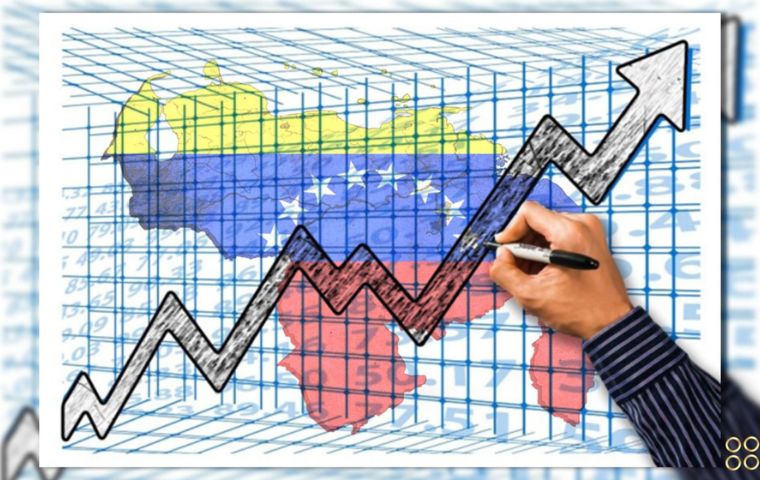
Its foundations are strong, promising, and, some would say, surprising. Yet no economist should be surprised that Venezuela is attracting global attention once the massive granite tombstone of twenty-first-century socialism is removed from a country blessed with opportunities across every sector.
Consider only a few indicators:
- There is broad consensus that Venezuela’s GDP will grow at a double-digit rate this year, likely exceeding 15 percent. No major economy in the world is expected to grow at such a pace, and much of that growth will be driven by private investment.
- Oil production is expected to rise from under one million barrels per day to approximately 1.5 million barrels per day, generating additional revenue through four channels: higher production volumes, higher international oil prices, the elimination of discounts that reached as much as 40 percent for China and other black-market customers, and the end of free oil shipments to Cuba.
- Venezuela is rapidly reintegrating into the international financial system. The country has rejoined SWIFT and has begun a formal normalization process with the IMF, which will facilitate renewed relations with the World Bank and the Inter-American Development Bank and restore access to crucial development financing.
- Through bonus payments, the government has modestly increased workers’ incomes. While insufficient given the magnitude of wage deterioration, the increase has been fiscally responsible because it was not financed through the destructive practice of printing money. More improvements can be expected as the economy strengthens, although meaningful wage gains will ultimately require reform of Venezuela’s labor law, one of Chávez’s most damaging legacies.
- Venezuela has fundamentally modernized its Hydrocarbons Law and Mining Law, opening the door to major global investment. The recent decision by Exxon to return, after having initially shown reluctance even in discussions with President Trump, demonstrates that few investors want to miss what may be one of the world’s most attractive emerging opportunities.
- Maiquetía International Airport, which should be the region’s premier air hub and had become nearly deserted, has returned to life. International connections now approach thirty destinations, and airlines from major global carriers to regional low-cost operators are seeking access to Venezuela.
- Important changes have been made within the government’s economic team, prioritizing technical competence over ideology. Many reforms remain necessary—in the Central Bank, the tax authority, banking supervision, PDVSA, the Comptroller’s Office, and FOGADE—but the shift toward supporting domestic and foreign investment marks a dramatic departure from the anti-business rhetoric of the “Expropriate It!” era.
- The foreign exchange market appears more stable than before January 3. The gap between official and parallel exchange rates has narrowed significantly and could disappear before year’s end. Ultimately, transparency—not merely intervention—is what allows markets to find equilibrium.
Finally—and perhaps most importantly—the government has announced its intention to undertake a comprehensive restructuring of Venezuela’s massive external debt.
This is essential to restoring public finances, regaining access to international capital markets, and reopening the door to concessional multilateral financing.
The First Goal of a Serious Economic Recovery Plan
Such an undertaking will require a highly qualified Venezuelan negotiating team, anchored by a technically strong Central Bank, supported by a unified political leadership and public consensus, and accompanied by the technical expertise and financial backing of the International Monetary Fund.
The task is enormous: cataloging the debt, classifying obligations by instrument, maturity, interest rates, legitimacy, and holders, organizing creditors into negotiating blocs, and presenting a realistic plan that demonstrates both Venezuela’s future potential and current limitations.
I am convinced that Venezuela can obtain substantial debt relief because international financial markets recognize that the opportunities available during the country’s coming decades of prosperity far outweigh the value of maintaining claims on debts that, in many cases, have already generated returns exceeding the original investment.
Given everything occurring in the economy during this New Political Moment, one would hope that Venezuela’s political class would understand the wisdom of prioritizing economics over electoral politics.
It is simply false to claim that economic recovery cannot occur before presidential elections are held. Economic recovery is already happening. It is substantial, solid, and rooted in the revival of Venezuela’s enormous oil sector—the most significant in the world.
The fact that the benefits have not yet reached all Venezuelans, particularly workers and pensioners, is a painful reality. Such outcomes are common during the early stages of economic recovery. These sectors require targeted policies and support rather than reliance on the normal pace of economic growth alone. Yet one cannot deny that a new economic reality has emerged. This recovery is not contingent upon immediate elections. On the contrary, it could be disrupted if the country were forced into another presidential election that simply replicated the political confrontation of July 28. Such a repetition would solve nothing and worsen everything.
Comparing today with 1999, when José Vicente Rangel appreciated both politics and economics, Venezuela now faces an extraordinary—perhaps unique—opportunity. We no longer have a charismatic caudillo—and thankfully so. But we do possess the lessons learned from decades of mistakes before, during, and after Chávez.
And because so much must be rebuilt, reconstruction itself—as happened in postwar Germany under the Marshall Plan—constitutes an extraordinary economic and political opportunity.
That is the opportunity many politicians, consumed by candidacies for elections that have not even been scheduled, fail to see.
It is also the opportunity that the Interim President’s government should embrace and project by making the ongoing process of economic recovery the centerpiece of its national narrative.
The time has come for a major political proposal that places the demand for immediate presidential elections in proper perspective and instead launches a broad effort, both within Venezuela and internationally, to showcase the extraordinary opportunity for prosperity and progress now before the nation.
That effort should be carried out in close partnership with the United States—a relationship that should never have deteriorated to the crisis of January 3 and that should return to what it once was: a mutually beneficial relationship between two nations with deep and enduring ties.
The article is a translation of Agustín Berríos, published by Punto de Corte, May 28, 2026, as part of a collaboration between both platforms. Agustin Berrios is an economist graduated from Harvard University, and a political leader in Venezuela that advocates for national reconciliation and a negotiated transition to democracy. He is the President of the National Reconciliation Party.
.