

Increasing temperatures are turning summer soccer into a battle, and the odds are stacked against the players
When the 2026 FIFA World Cup kicked off, 48 nations began their chase for soccer’s ultimate prize. But as fans pack into stadiums across the United States, Mexico, and Canada, a less welcome competitor is already on the field: heat.
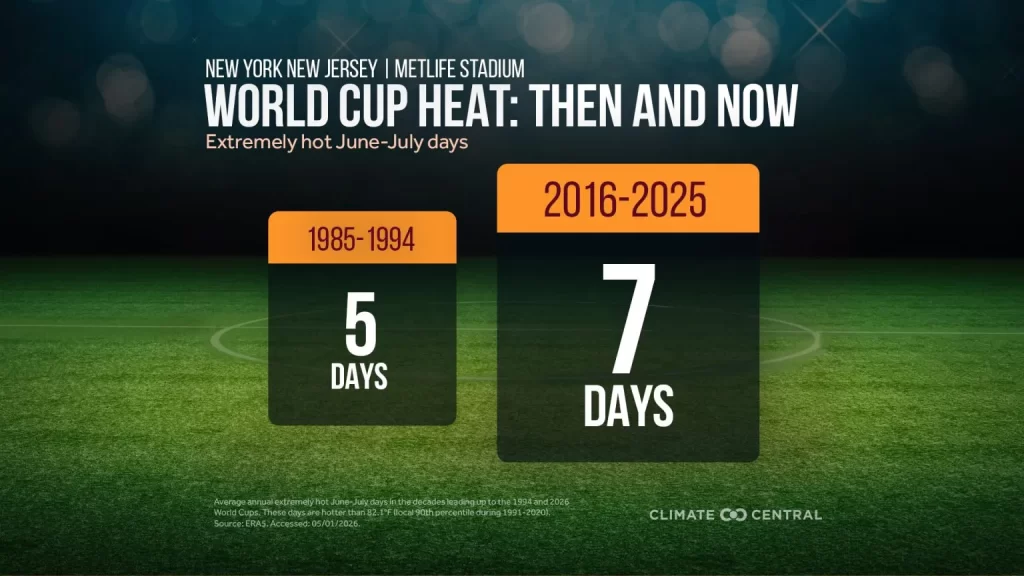
A new analysis by Climate Central reveals that higher temperatures are boosting the likelihood of performance-impairing heat at 97 of the tournament’s 104 scheduled matches.
That’s nearly every game.
Nearly all 16 host stadiums are seeing more extremely hot days in June and July than they did during the World Cup in 1970, according to Shel Winkley, senior engagement specialist and meteorologist for Climate Central.
The findings raise urgent questions about player safety, match strategy, and the future of outdoor sports in a warming world.
Below are Climate Central’s most pressing findings. Its website also features the World Cup hub, a tool that allows users to explore the heat data from multiple angles: by match, team, stadium, or city. It’s live, publicly accessible, and includes both graphics and raw data.
When Heat Becomes the Opponent
Scientists have a number in mind this summer: 82.4 degrees Fahrenheit, or 28 degrees Celsius. Research from the 2014 World Cup in Brazil found that once temperatures cross that threshold, soccer players begin to slow down.
For teams whose game plans depend on speed, relentless pressing, or high-intensity transitions, excessive heat changes the game entirely.
Nearly half of this year’s World Cup matches, 49 of 104, have at least a 50% chance of hitting that mark.
“Studies show that once temperatures cross 82°F, soccer players start to run slower, cover less ground, and sprint less frequently,” Winkley notes. He adds that for players already pushing their bodies to the limit, “this raises the risk of heat cramps, heat exhaustion, and even heat stroke.”
The most extreme case comes on June 26 in Guadalajara, Mexico, where Uruguay faces Spain. That match carries a 70% probability of performance-impairing heat. Without a warming atmosphere, those two teams would be far more likely to compete in manageable conditions.
A City-by-City Risk
Not all venues face equal risk. Cities in Mexico, including Guadalajara, Mexico City, and Monterrey, carry some of the highest heat exposure during the June schedule, when the group stage is played under peak summer sun.
In the United States, the picture is more mixed. Stadiums in Atlanta, Dallas, and Houston offer a significant advantage: they are the only climate-controlled venues in the entire tournament. Players and fans inside those domes will be largely shielded from outdoor heat. But the remaining 13 stadiums are open-air, leaving everyone exposed to the elements.
Even the World Cup final, set for July 19 at MetLife Stadium, officially listed as New York New Jersey Stadium, is not immune. Whichever two teams battle for the trophy that day will face a 47% chance of performance-impairing heat.
Organizers Adapt, Challenges Remain
World Cup organizers are not ignoring the risk. More evening kickoffs have been scheduled in the hottest host cities to take advantage of cooler nighttime temperatures. Mandatory hydration breaks have been built into all 104 matches. And if the wet-bulb globe temperature (a measure of humid heat that accounts for the body’s ability to cool itself) reaches 89.6 degrees Fahrenheit (32 degrees Celsius), matches can be postponed entirely to protect players and staff.
Still, precautions can only go so far. Most stadiums remain open to the sky, and millions of fans will sit under the sun for hours. Heat stress is a genuine health risk, particularly when humidity compounds the extreme temperatures common in summer across the Sun Belt and parts of Mexico.
What’s at Stake
The 2026 World Cup arrives as a live experiment in what shifting climate patterns mean for elite outdoor athletics. The stakes (national pride, years of preparation, and the health of the world’s best players) make it impossible to ignore.
As the tournament unfolds, the most decisive factor on the field may not be tactics, fitness, or even talent. It may be the temperature at kickoff.
This piece was provided by VoLo Foundation, a nonprofit organization that exists to accelerate change and global impact by supporting science-based climate solutions, enhancing education, and improving health.