

For the transition to democracy in Venezuela, we need to revisit our own history — not to repeat it mechanically, but to recover experiences that can help us find our place in this new world. One of them is the relationship Venezuela and the United States built beginning in 1958.
During the early years of the Cold War, Washington sought stable governments, favorable to private investment and, above all, unequivocally anti-communist. Democracy was not always a priority; at times it was considered dangerous, out of fear that it would open space for popular or left-wing movements. Military dictatorships and conservative Latin American elites fit that conception well, offering order, guaranteeing certain economic interests, and presenting themselves as a bulwark against communism.
General Marcos Pérez Jiménez was one of those beneficiaries. In 1954, the Eisenhower administration awarded this dictator the Legion of Merit in its highest degree, recognizing his cooperation with the United States and his openness to American capital in oil development. TIME put him on its cover in February 1955 as an effective modernizer. Yet in the dictatorship’s final days, Washington adapted quickly to the new reality: in less than twenty-four hours it recognized the Governing Junta of Wolfgang Larrazábal, formed after the dictator’s overthrow. The turn was revealing: the United States did not produce Venezuela’s change, but it knew how to recognize it and stopped standing in the way of the transition.
Democracy as strategy
Rómulo Betancourt, the father of Venezuela’s democracy, understood before most that the struggle against dictatorships could not be framed in moral terms alone. It had to be shown that democracy was also the more convenient alternative for political stability, economic development, and the containment of communism. Poverty and exclusion were fertile ground for authoritarian adventurers; the best antidote was not another dictatorship, but a democracy capable of producing social progress.
Betancourt was no naïf. He had learned the lessons of the three-year period in which his party, Acción Democrática, governed — a period that began in 1945 and ended in a traumatic interruption in 1948. He knew that anti-imperialist rhetoric could mobilize the opposition, but was insufficient as a policy of state. Once in government, Venezuela needed a constructive relationship with its principal oil market. That relationship, however, could not be founded on subordination: on certain matters Venezuela could act without the United States, but it made no sense to act against the United States. Cooperating did not mean obeying. That was one of his greatest insights — making Venezuela’s national interest compatible with a reliable alliance with Washington.
As much market as possible
President Betancourt’s economic thinking could be summed up in a formula that years later became common in European social democracy, attributed to the German social democrat Willy Brandt: as much market as possible, as much government as necessary. Private enterprise and foreign investment were indispensable for creating wealth, but the state had the responsibility of guaranteeing education, health, housing, and infrastructure. This was not a choice between capitalism and social justice, but the construction of a market economy accompanied by a democratic state capable of correcting inequalities and expanding opportunity.
Oil as a meeting point
Social transformation required a sufficient fiscal base. Betancourt defended the fifty-fifty principle over Venezuela’s oil revenues, but also insisted that the split be calculated on oil’s real value: if the major companies unilaterally set prices and production, formal equality could conceal an unequal relationship. He did not propose immediate nationalization — Venezuela needed technology, capital, and markets — but he did seek greater control over its fundamental resource. That is why he backed his energy minister, Juan Pablo Pérez Alfonzo, in his push to coordinate among exporting countries. The founding of OPEC in September 1960 — with Venezuela, Saudi Arabia, Iran, Iraq, and Kuwait as founding members — was an exercise in economic sovereignty aimed at preventing companies from arbitrarily setting the terms of the resource. The Venezuelan formula was clear: guarantees for investment, respect for property, and openness to international markets, but also fair prices, just taxation, and national capacity to manage the oil supply. This was not statism against the market. It was sovereignty within the market.
Betancourt and Kennedy
Betancourt did not ask the United States to liberate Venezuela. He worked to convince influential sectors that supporting dictatorships did not serve their interests, and that they should allow Venezuelans to govern themselves democratically. Pérez Jiménez’s fall was the work of Venezuelans — civil resistance, parties, students, unions, the Church, and the military — and Washington’s contribution was simply to stop protecting the dictator.
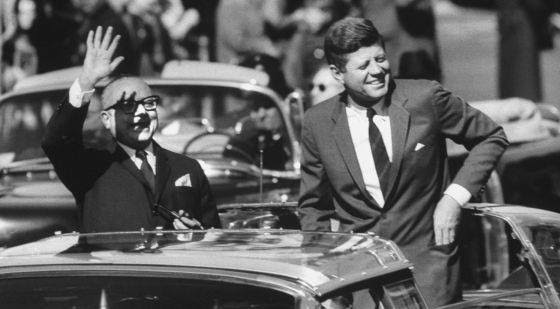
John F. Kennedy grasped the hemispheric dimension of Rómulo Betancourt’s approach. He updated the Good Neighbor Policy through the Alliance for Progress, seeking to show that the United States could engage Latin America through socioeconomic development and democratic institutions, not only through military agreements or the dominance of its multinational companies’ interests. During his visit to Venezuela in December 1961, Kennedy found in Betancourt an exceptional counterpart, and both reaffirmed that social progress was inseparable from democratic stability. At the same time, major American fortunes deepened their bet on Venezuela — the most emblematic case being the Rockefeller family — helping incorporate the country, with growing dignity, into the international economic map.
The Betancourt Doctrine
The relationship with the United States never meant giving up an independent foreign policy. That conception found expression in the Betancourt Doctrine: the rejection and isolation of governments born of force and lacking democratic legitimacy. It was not a doctrine against one particular ideology: it was directed as much against Fidel Castro’s Marxist authoritarianism as against the military and oligarchic dictatorships of the right.
Betancourt confronted Castro — whom he called “el barbazas del Caribe” (“the big beard of the Caribbean”) — because he rejected Castro’s ambition to export the Cuban Revolution. His famous reply — that when Venezuela needed liberators, it did not import them, it gave birth to them — was a message aimed at Havana, but it carried a universal claim. That same firmness showed itself toward General Rafael Leónidas Trujillo, whose regime organized the attack that nearly cost him his life in 1960; with the support of other democratic governments, Venezuela pushed through the OAS for sanctions against the Dominican dictatorship. Consistency was essential: one could not condemn authoritarianism on the left and tolerate it on the right.
A lesson for our time
Venezuela today needs to recover that tradition of democratic autonomy. And U.S. policy should emulate the Alliance for Progress.
As someone who carries both countries in one passport, I don’t experience this as a negotiation between two separate “we’s” — a Venezuelan we and an American we — but as a single conversation with myself. We do not need to ask any power to decide our destiny, but we can commit to being the kind of ally worth choosing: not by deciding for Venezuela, but by standing behind it once Venezuelans decide for themselves. We don’t have to choose between isolating Venezuela from the United States or subordinating it to Washington — we can build a mature relationship, grounded in shared interests, clear rules, and mutual respect. We can attract American and international capital and help Venezuela reintegrate into global markets, while insisting on a fair share for Venezuelans in their own energy wealth. Venezuela can be an ally without being a dependent; the United States can cooperate without dictating; and together we can open Venezuela’s economy without asking it to give up its national interest. That, to me, is what a dual citizenship teaches better than any treaty: a partnership only holds when neither side has to disappear into the other.
JFK and Rómulo Betancourt’s great lesson is that sovereignty is not defended through isolation or stridency, but by building legitimate institutions, a productive economy, and a society capable of governing itself. They also understood that social justice was not an ornament of democracy, but one of the conditions for its survival.
A final reflection
Venezuela is living through an unprecedented situation today. A de facto tutelage exists, arising from circumstances that still condition the country’s development, coinciding with a weakened state and an economy exhausted after a prolonged political conflict. In that context, I have said before — and I repeat it — that it makes sense to build a national accord in Venezuela and a bipartisan consensus in the United States around the three-phase plan proposed by Secretary of State Marco Rubio: stabilization, recovery, and democratic transition.
Accepting this approach does not mean abandoning the concept of sovereignty that animates this article. It means recognizing a concrete reality and taking it on as a challenge to overcome, not as a condition to resign ourselves to. Betancourt, too, did not start from a position of strength: he inherited a country in economic crisis and a relationship with Washington laden with mutual suspicion, and he turned that weakness into the starting point for a patient construction of real sovereignty. That is the lasting relevance of his lesson today: the de facto tutelage we face is not overcome by denying it or answering it with stridency, but by working, as Rómulo did, to transform an unequal relationship into a partnership between equals — until the word tutelage no longer describes the relationship between Venezuela and the United States.
That must be the horizon: a Venezuela stabilized, rebuilt, and finally democratic; a friend and ally of the United States in building an economy of mutual benefit; a sovereign Venezuela, respected and master of its own destiny.