

A new nationwide DatinCorp poll finds cautious personal optimism alongside economic strain, support for negotiated change, firm defense of sovereignty, and sweeping dissatisfaction with the country’s political leadership.
By the IQLatino Team | August 26, 2026
| AT A GLANCE Among 1,200 registered voters, 69% say Venezuela needs new political leadership, 66% prefer someone completely new over a figure from existing parties, 50% identify negotiation as the most realistic route to change, and 51% say economic problems should be the president’s first priority. |
A public looking beyond the old divide
A new national survey by DatinCorp offers a striking portrait of Venezuela in August 2026: a country still burdened by economic insecurity and political distrust, yet more hopeful about family life than the national debate might suggest—and deeply impatient with both government and opposition leadership.

The DatinCorp study does not describe a public rallied around a single leader or ideological camp. It shows something more consequential for Venezuela’s transition: a broad demand for economic competence, negotiated results, political renewal and respect for national sovereignty. The electorate appears willing to support engagement and compromise, but not to issue a blank check to any of the actors now claiming to speak on its behalf.
Cautious optimism survives hardship
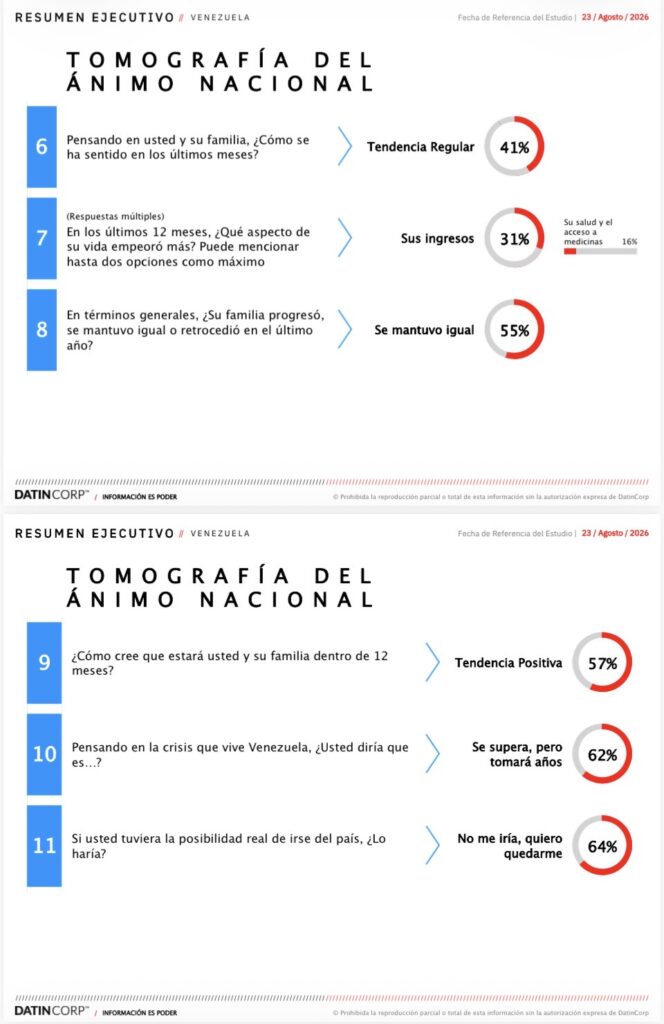
The economic pressure is unmistakable. Thirty-one percent identify income as the area of life that deteriorated most during the past year, while 16% point to health and access to medicine. Fifty-five percent say their family neither advanced nor fell back over the same period, and 41% describe their recent personal and family experience in mixed or middling terms.
Yet the survey also reveals resilience. Fifty-seven percent expect their personal or family situation to improve over the next 12 months. Sixty-two percent believe the national crisis will ultimately be overcome, even if it takes years. And 64% say they would remain in Venezuela even if they had a genuine opportunity to leave.
That combination—material strain, long time horizons and a desire to stay—matters. It suggests that Venezuelans are not simply waiting for an exit. Many are looking for a credible route to rebuild their lives at home.
The economy is the test of political legitimacy
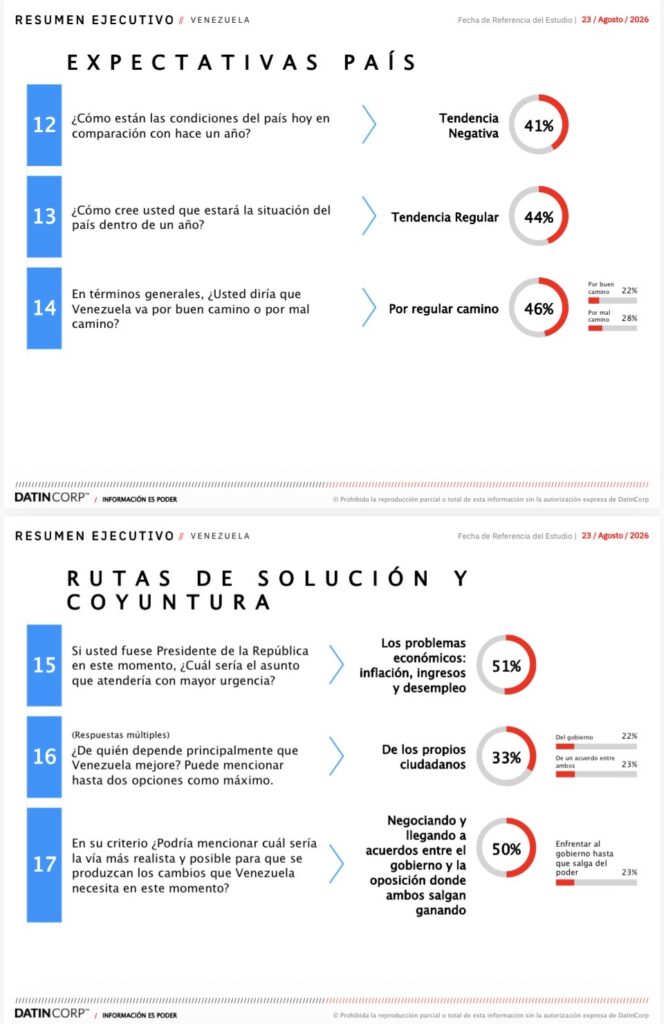
Asked what they would address first if they were president, 51% choose inflation, income and unemployment. Political questions such as elections, political prisoners and party legalization remain central to a democratic transition, but the survey indicates that citizens will measure political progress through its effect on daily life.
This is also visible in the public’s reading of the U.S. roadmap. Thirty-five percent say democratic and credible elections should come first, while 34% choose reconstruction of the economy and public services. The near tie is revealing: Venezuelans do not necessarily see institutional legitimacy and material recovery as competing agendas. They expect both.
Negotiation is preferred—but expectations are modest
Half of respondents say negotiations in which government and opposition both gain something are the most realistic path to the changes Venezuela needs. By comparison, 23% favor confronting the government until it leaves power, and 8% would simply wait for it to collapse.
This preference for negotiation should not be confused with confidence in the negotiations now under way. Only 21% expect important changes from the talks; 41% foresee limited changes and 31% expect no result. The public also knows relatively little about the process: 37% say they are very poorly informed, 32% are only somewhat aware and 20% know nothing about it.
The gap between support for a negotiated path and weak confidence in the current process is one of the poll’s most important findings. It points to a communications deficit, but also to a credibility problem. Negotiators will have to demonstrate concrete achievements—not merely defend the existence of dialogue.
U.S. engagement has support—and limits
The poll presents a nuanced view of the United States. Forty percent describe President Donald Trump’s strategy for resolving the Venezuelan crisis as somewhat correct, the largest single response, while 22% call it somewhat mistaken. Fifty percent believe the current U.S.–Venezuela understanding benefits both countries equally; 33% say it benefits only the United States.
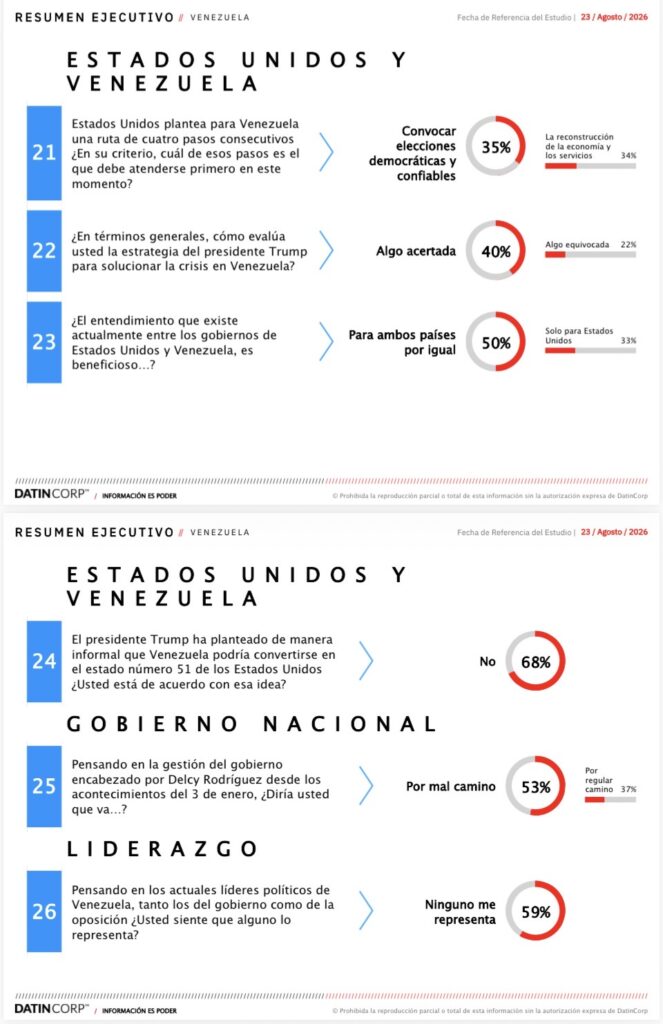
But Venezuelans draw a bright line around sovereignty. Sixty-eight percent reject the informal suggestion that Venezuela could become the 51st U.S. state. The message is not isolationism. It is conditional engagement: U.S. participation can be accepted when it advances democratic elections, reconstruction and a balanced bilateral relationship, but not when it is framed as tutelage or annexation.
A leadership vacuum, not a consolidated mandate
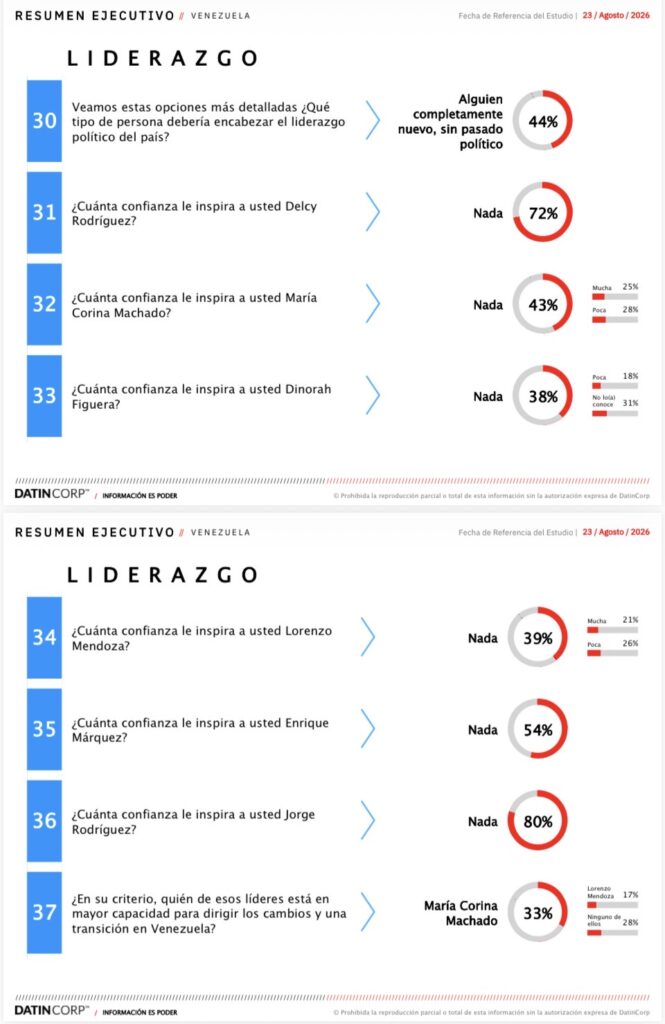
The sharpest verdict concerns the political class. Fifty-nine percent say none of the current government or opposition leaders represents them. Sixty-nine percent say the country’s present leadership is inadequate and must be replaced. Sixty-six percent prefer a completely new leader rather than someone from existing parties, and 44% specifically favor a person with no political past.
The attributes voters seek are equally instructive: knowledge of economics and the ability to govern tie with honesty as the most important leadership quality, each cited by 27%. The desired profile is therefore neither merely technocratic nor merely moral. Venezuelans want both competence and integrity.
María Corina Machado is the strongest of the named figures, but the data do not amount to a consolidated national mandate. Thirty-three percent identify her as best positioned to lead change and a transition, ahead of businessman Lorenzo Mendoza at 17%. At the same time, 28% choose none of the listed figures. On confidence, 25% express a great deal of confidence in Machado, 28% little confidence and 43% none.
Her support is also geographically uneven. In the Andean states of Táchira and Mérida, 71.7% report a great deal of confidence in her, compared with 25% nationally. Outside that region, her strong-confidence rating is much closer to—or below—the national average. Confidence is also softer among lower-income urban respondents: 17.5% express a great deal of confidence and 50.8% none. The rural subsample is too small to interpret reliably.
Government leaders fare worse. Seventy-two percent express no confidence in Delcy Rodríguez and 80% say the same of Jorge Rodríguez. Fifty-three percent say the government headed by Delcy Rodríguez since January 3 is on the wrong path, while 37% describe its course as middling.
The party system faces an existential challenge
The rejection extends beyond personalities. Sixty-five percent identify as independent or unaligned, and 67% name no political party when asked an open-ended question. Thirty-four percent say existing parties should disappear and be replaced, while 31% call for radical transformation and 21% favor moderate internal reform.
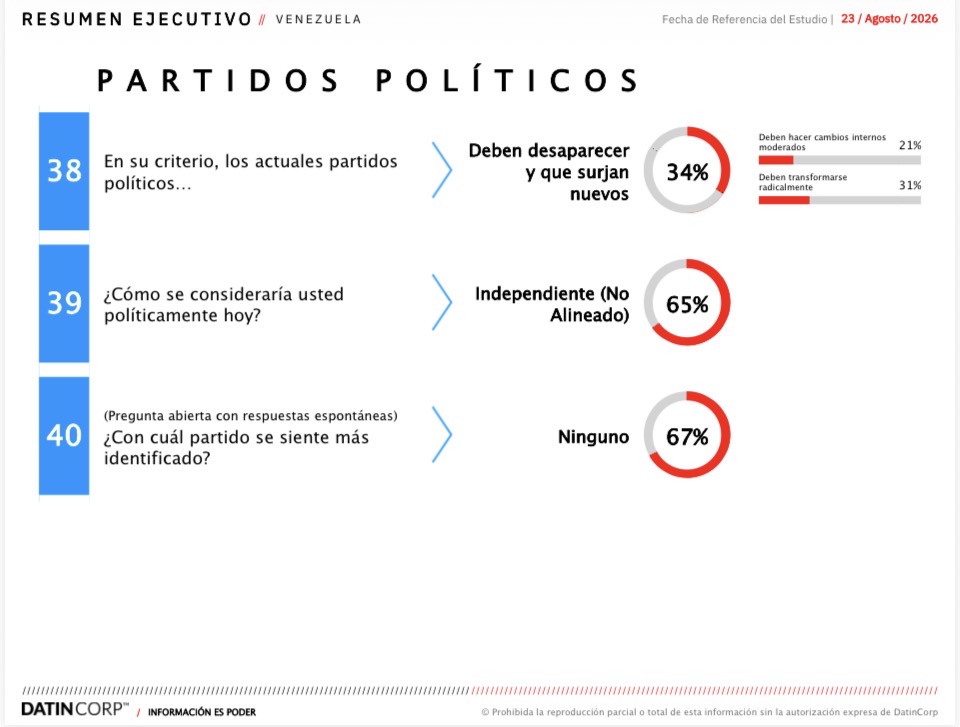
Taken together, those responses suggest that Venezuela’s next political majority may not be assembled simply by recombining familiar party brands. Existing organizations face a choice: renew their leadership, internal democracy and capacity to solve problems—or leave space for a new political offer.
What the poll means for the transition
Five takeaways emerge. First, economic recovery will be the public test of any transition. Second, negotiation has more social legitimacy than confrontation, but the current talks must produce visible results. Third, U.S. involvement can be constructive only when it supports Venezuelan democracy and sovereignty. Fourth, no current leader should mistake relative advantage for broad national consent. And fifth, the appetite for new leadership and new parties is not marginal; it is the dominant political signal in the survey.
The poll ultimately describes a society that wants change without another cycle of maximalism. Venezuelans appear ready to support a democratic settlement that restores credible elections, improves livelihoods and opens the system to new leaders. The opportunity is real. So is the warning: a transition negotiated only among established elites, without tangible economic progress or a convincing renewal of representation, could quickly lose the public it is meant to serve.
Methodology and source
DatinCorp interviewed 1,200 registered voters in person at their homes using a four-stage semi-probabilistic sample. The survey covered Caracas and 16 states representing approximately 90% of Venezuela’s electoral population. DatinCorp reports a margin of sampling error of ±2.83 percentage points at a 95% confidence level and 100% field supervision. The study’s reference date is August 23, 2026. Multiple-response questions may total more than 100%. Subgroup results—especially very small cells—should be interpreted with caution.
Source: DatinCorp, “Coyuntura Política—Venezuela,” Analysis and editorial framing by the IQLatino team with the support of the Venezuela Initiative Fellows of Center for Democracy and Development in the Americas (CDDA).