

Electricity sector legal reform, renewed engagement with the Inter-American Development Bank, and fresh activity in the oil sector are expanding Venezuela’s options for recovery. The fourth round of political talks happened with progress on political guarantees regarding freedom of speech, decriminalizing dissent and Supreme Court reform. Negotiations to reconstitute the electoral council or a timetable for a presidential election are expected early next year. The Interim government and its advisors unveiled a finance and economic plan named “Venezuela Renace”, tainted with a highly disputable foreign debt profile.
By IQ Latino DC / Caracas Desks | November 28, 2026
Venezuela now has a framework to prepare reconstruction projects with the Inter-American Development Bank and a reform that opens the electricity sector to private investment. In oil, ExxonMobil is assessing a possible return, while Canada’s Ensign Energy has already moved another drilling rig into the country. At the negotiating table, however, the fourth round of talks ended on November 23 without an announcement on how or when the National Electoral Council (CNE) would be reconstituted.
Talks resume in December with electoral guarantees still pending
The government and the 2015 National Assembly delegations, led by Jorge Rodríguez and Dinorah Figuera, agreed to meet again in December. They kept on the agenda a review of the status of political parties barred from participating and of the laws against hate and terrorist financing. They also agreed to begin regularizing certain radio and television licenses and to continue seeking the release of Venezuelan gold held at the Bank of England to help address the effects of the June earthquakes. The gold has yet to be released.
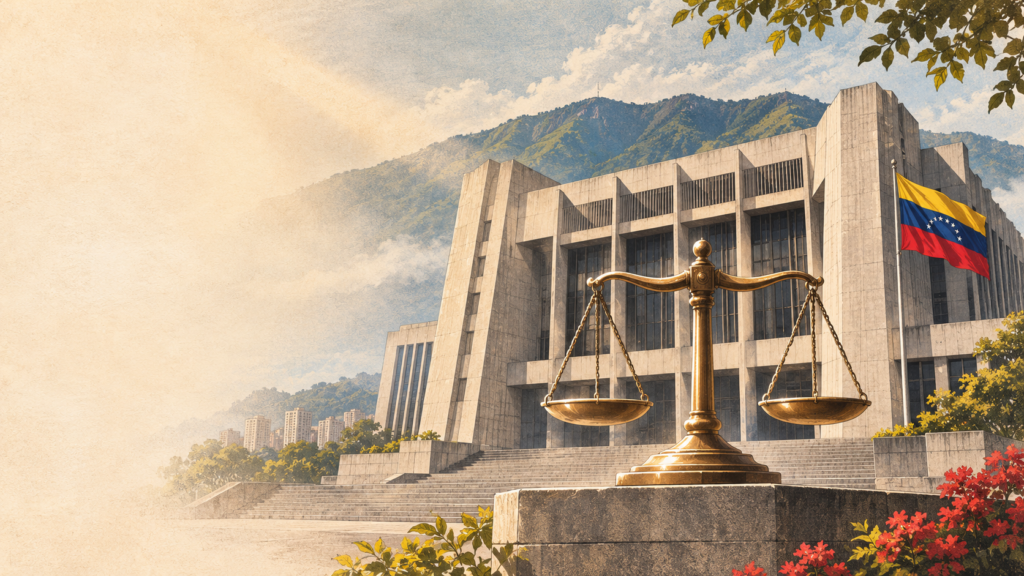
The effort to renew Venezuela’s Supreme Tribunal of Justice (TSJ) is one of the most concrete results of the U.S.-backed dialogue so far. An August agreement between the government and the delegation of the National Assembly elected in 2015 has moved into implementation: on November 20, the Judicial Nominations Committee published a list of 1,066 applicants for 32 seats on the country’s highest court. The public has until December 5 to file objections. Opening the nominations to public scrutiny is a meaningful step toward restoring confidence in the judiciary.
The process deserves support, and its credibility will depend on how the final choices are made. The committee should publish its evaluation criteria, explain how it resolves objections, and show how the nominees meet standards of legal competence, integrity, and independence. As the Inter-American Commission on Human Rights has emphasized, the renewal should help reverse political control over the judiciary. A court capable of ruling independently would strengthen the protection of political rights and provide a more credible forum for resolving electoral disputes. That makes judicial reform a reason to build on the dialogue’s progress and move in parallel on renewing the CNE, establishing electoral guarantees, and setting a timetable for a competitive presidential election.
The fourth round of talks, which closed on November 23, took a welcome step toward easing restrictions on free expression and political participation. The delegations agreed to join a national consultation on reforming the Law Against Hate (Ley contra el Odio), with the stated aim of decriminalizing certain conduct, narrowing vague provisions that allow arbitrary enforcement, and shifting from punishment toward education and prevention. They also agreed to open a discussion of the Simón Bolívar Law (Ley Simón Bolívar) the National Assembly’s next plenary session. The Bolivar Law is a 2024 statute that imposes up to 30 years in prison, 60-year political bans, and asset seizures on individuals or organizations accused of promoting or supporting foreign sanctions against the state.
These are distinct commitments: one sets out goals for a reform consultation; the other puts a law on the legislative agenda. Neither changes the law by itself. The next test is whether the resulting legislation protects peaceful criticism and political advocacy, and whether authorities review cases brought under provisions that penalize the exercise of those rights. Joint communiqué, November 23
Electricity and reconstruction: From legal reform to financeable projects
On November 10, the National Assembly approved a reform allowing private participation in the electricity sector through joint ventures with the state for up to 25 years, as well as through contracts with state oil companies. Three days later, the IDB unanimously approved its 2026–2028 Country Engagement Note for Venezuela, focused on electricity, social protection, and earthquake reconstruction. The plan begins with technical assistance and project preparation. IDB Invest is considering selective loans and guarantees. Public-sector loans would require separate approvals and remain subject to Venezuela resolving its arrears to the bank, estimated at about $2.3 billion at the end of September. Reuters: electricity reform · Reuters: IDB engagement
Substation rehabilitation and power generation for industrial customers offer potential entry points. Before committing capital, developers would need to establish who buys the electricity, how tariffs are set, what currency payments are made in, and what guarantees support those payments. Transparent project selection, disclosure of beneficial ownership, and environmental and social assessments would help turn the legal opening into projects investors can finance.
Transparency also matters for Venezuela’s own revenues. A KPMG report released by the U.S. State Department showed that approximately $12.26 billion flowed into the U.S.-administered custody account through September and that roughly $12.11 billion was disbursed, primarily through Venezuelan foreign-exchange auctions. Those figures show the scale of the mechanism. Assessing its contribution to reconstruction requires more information about who ultimately received the funds and what the spending accomplished.
Oil: Exxon weighs a return while Ensign moves equipment
ExxonMobil’s memorandum of understanding with PDVSA is nonbinding. According to Reuters, the company is assessing seven areas and has one year to review data and negotiate on an exclusive basis. One of the assets under review is Petromonagas, where Russian participation remains unresolved. The memorandum gives Exxon a chance to evaluate a return after its assets were expropriated in 2007, but it does not commit the company to investing.
Ensign offers a more concrete sign of activity. Its CEO told Reuters that the company has already moved a third rig to Venezuela from the Permian Basin and that a fourth is on its way from Australia. The goal is to expand from two rigs to 15 over two years, although ten of the planned rigs still depend on negotiations with customers. For private investors, one possible entry point is to finance certified equipment, maintenance, or logistics against firm orders from authorized operators. Before acquiring assets, investors should verify sanctions coverage, customer creditworthiness, payment and repatriation terms, insurance, and import costs.
The Essequibo dispute adds a regional dimension. A former State Department official acknowledged holding preliminary talks on the dispute at the White House’s direction. Sources cited by Reuters said possible partial Venezuelan control was raised; Washington assured Guyana that its official position on the boundary had not changed. That distinction matters for operators in the region, including Exxon, which leads the consortium developing Guyana’s Stabroek Block. The contacts do not alter the proceedings pending before the International Court of Justice.
December brings two concrete tests: whether negotiators turn their commitments into verifiable electoral guarantees, and whether the economic opening starts to yield projects governed by public rules, with traceable payments and clear accountability. Recovery can move forward now. Its durability will depend in large part on whether the institutions that support it also gain legitimacy.
Venezuela Renace puts the scale of the debt challenge in focus.
The government’s Venezuela Renace plan, released on November 24, puts economic stabilization and a comprehensive debt restructuring at the center of the recovery agenda. It identifies $237.5 billion in public-sector liabilities at the end of 2025, equivalent to 242% of GDP. The $260 billion figure in the public debate is the upper end of a broader estimate that factors in potential new borrowing. Even the official total is broader than the amount owed to outside creditors: it includes sovereign and PDVSA bonds, supplier and joint-venture obligations, arbitration claims, and at least $35 billion that PDVSA owes to other public entities. The disclosure gives creditors and policymakers a common starting point. The next test is a debt sustainability analysis that reconciles those claims, tests the plan’s oil and growth assumptions, and shows what Venezuela can realistically repay while leaving room to rebuild essential services and infrastructure.