
By IQ Latino
Caracas—Two months after the political developments of early January, Venezuela appears to be living through a paradox: a society that feels hope, but trusts almost no one.
A new nationwide survey conducted by DatinCorp (March 2026) captures a country in transition—psychologically open to change, yet structurally skeptical of its leadership and institutions.
A Surprising Finding: Hope Leads
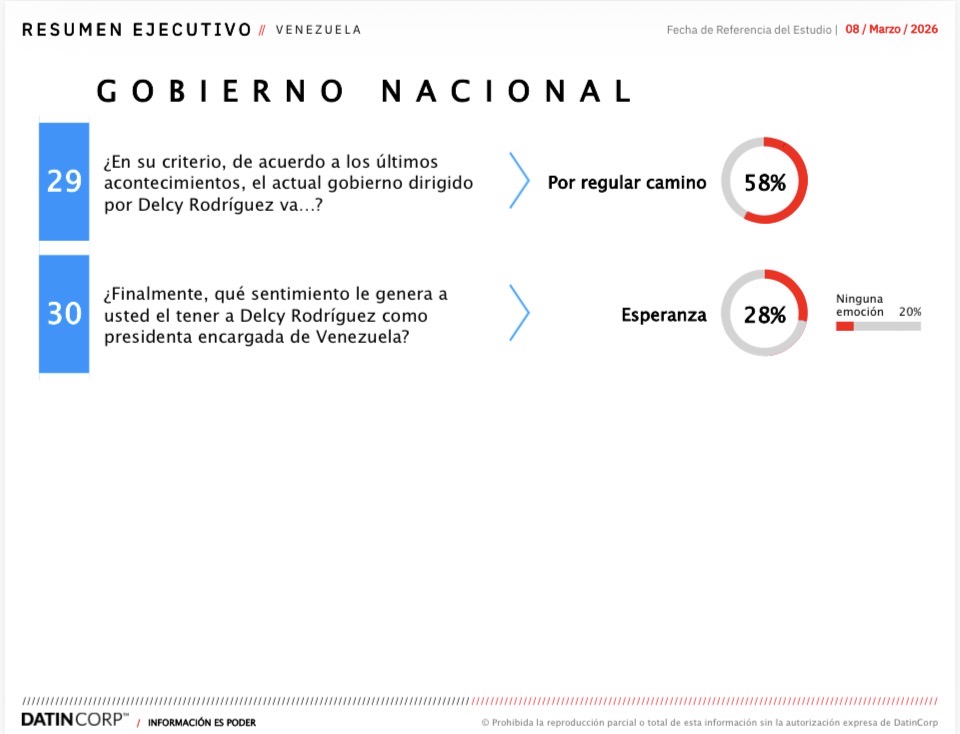
In a country shaped by years of crisis, the dominant emotion today is not anger or despair—it is hope.
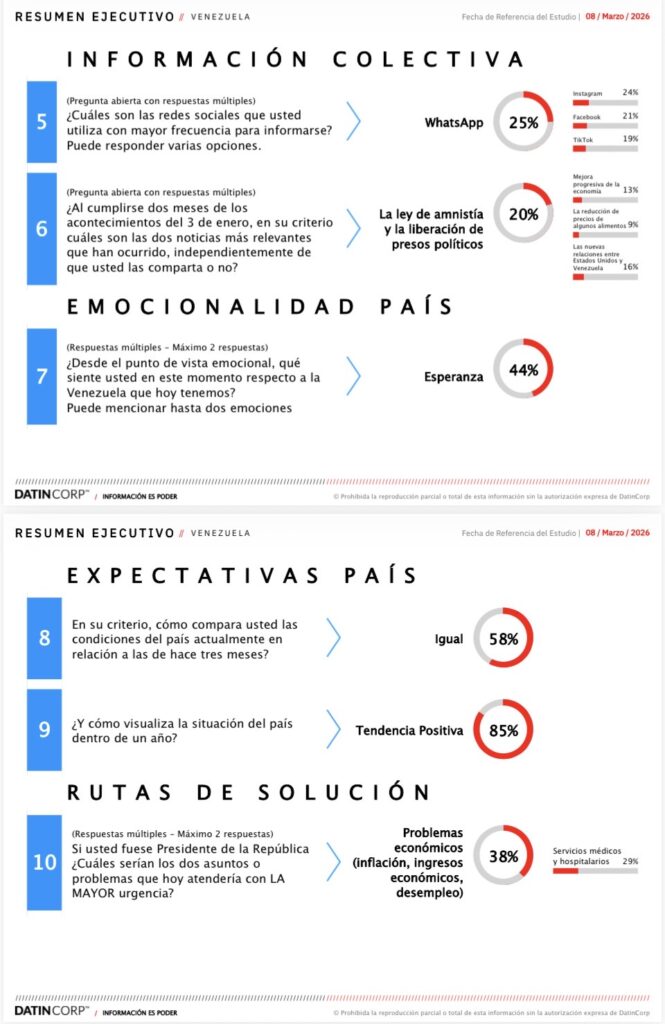
According to DatinCorp, nearly half of Venezuelans (44%) say they feel hopeful about the country’s current direction.
But this optimism is fragile.
A majority still sees no meaningful improvement in their daily conditions compared to three months ago, suggesting that hope is being driven more by political signals—agreements, diplomatic openings, prisoner releases—than by tangible economic change.
The Collapse of Political Identity
Perhaps the most consequential finding in the DatinCorp survey is this:
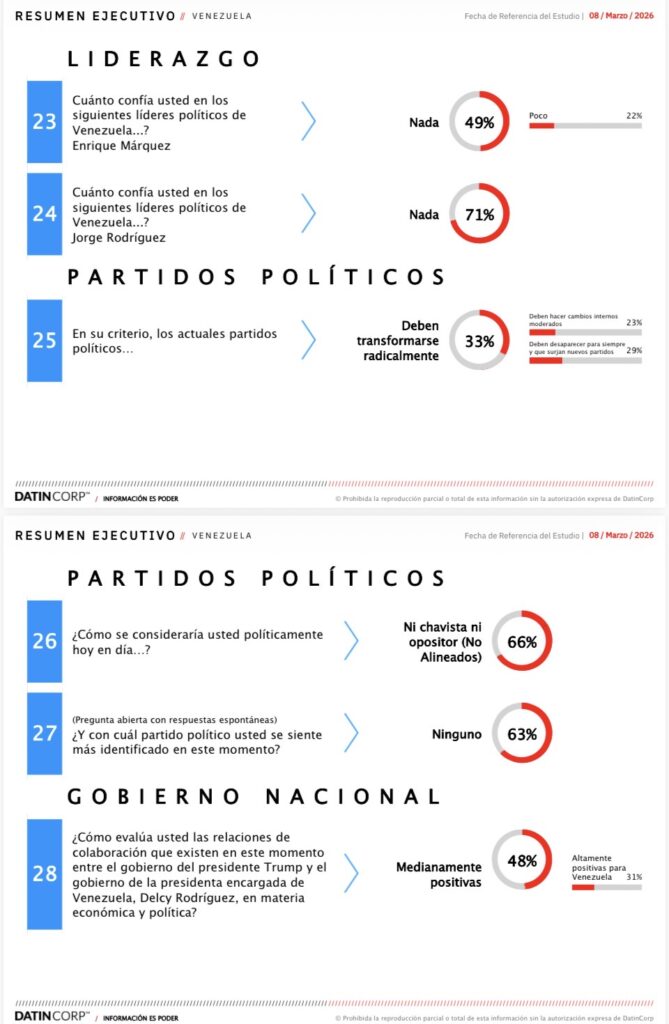
Two-thirds of Venezuelans (66%) no longer identify with either the government or the opposition.
Even more striking, 63% say they do not identify with any political party at all.
This is not polarization—it is disengagement.
Venezuela is no longer a country divided between two blocs. It is a country where the majority stands outside both.
Stability Over Speed
Contrary to expectations, Venezuelans are not demanding immediate elections.
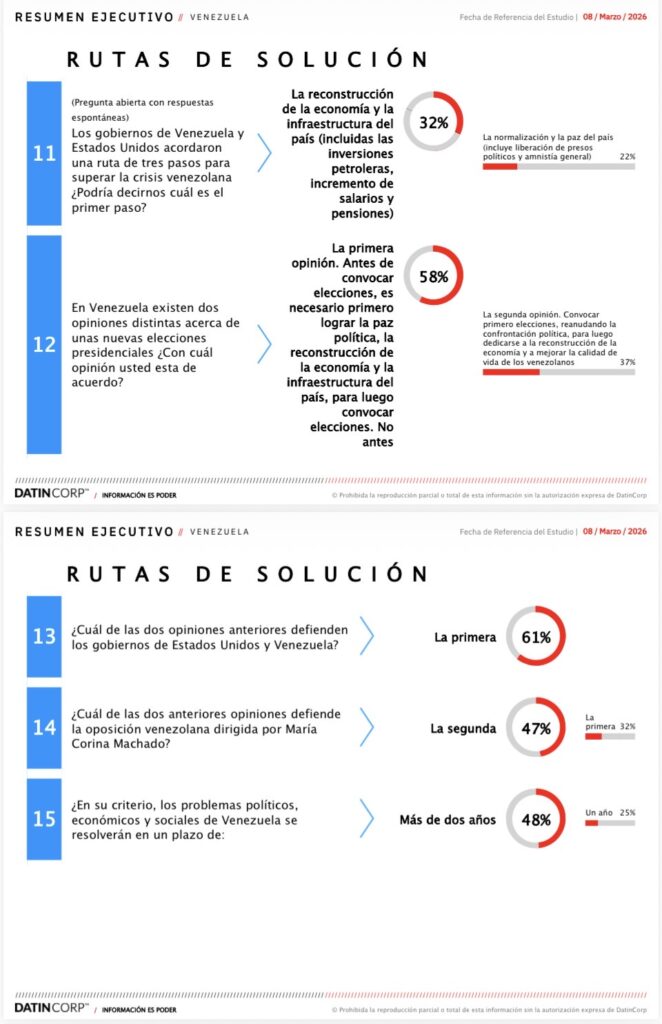
Instead, the DatinCorp poll shows that 58% support a sequencing approach: stabilize the country first—economically and politically—and only then move toward elections.
This reflects a shift in priorities. After years of instability, the electorate appears to value order and recovery over confrontation and immediacy.
The Economy Still Rules
Despite political developments, everyday concerns remain unchanged.
Economic hardship—income, inflation, employment—remains the top priority for Venezuelans, followed by access to healthcare, according to DatinCorp’s findings.
This underscores a fundamental reality:
No political agreement will endure without visible improvements in people’s lives.
Amnesty: A First Step, Not a Conclusion
The release of political prisoners under the new amnesty framework is widely seen as significant.
The DatinCorp survey finds that 44% of respondents view it as the beginning of a lasting peace, while a significant share remains cautious and wants to see more evidence.
Trust, after all, is not granted—it is built.
A Leadership Vacuum—with a Relative Outlier
Across the political spectrum, trust in leaders remains strikingly low.
DatinCorp data shows that large majorities express little or no confidence in both government and opposition figures, with no leader commanding majority trust.
Yet within this generalized rejection, the survey reveals an important nuance: María Corina Machado holds a relative advantage within an otherwise fragmented leadership landscape.
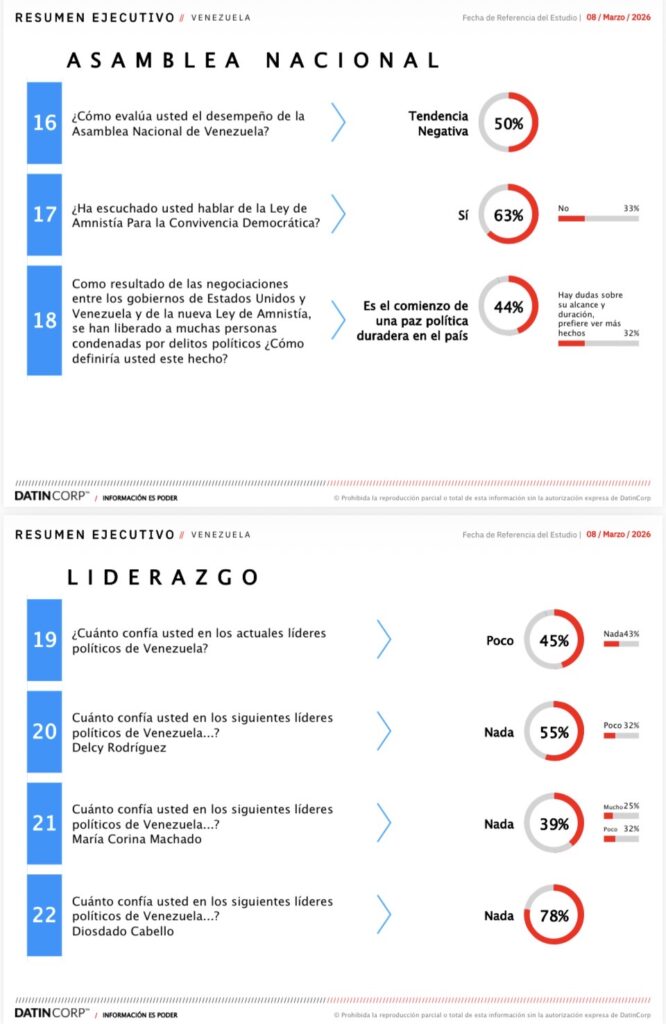
Although a plurality of respondents still report low or no trust in her, Machado registers the highest levels of strong support (“much trust,” around 25%) among major national figures, outperforming both government leaders and other opposition actors.
By contrast, figures associated with the governing establishment—such as Delcy Rodríguez and Diosdado Cabello—face significantly higher outright rejection levels, with “no trust” figures exceeding 55% and 75% respectively.
The takeaway is not dominance, but asymmetry:
Machado appears to command the largest identifiable base of conviction support, even as the broader electorate remains deeply skeptical of all political actors.
In a country where two-thirds of voters are politically non-aligned, that distinction matters—but it is not yet decisive.
A Long Road Ahead
Venezuelans are not naïve about what comes next.
Nearly half believe it will take more than two years to resolve the country’s political, economic, and social challenges, according to the survey.
There is patience—but it is conditional.
A Window, Not a Guarantee
Taken together, the DatinCorp poll paints a clear picture:
Venezuela is in a window of opportunity, not a resolved transition.
There is:
- Hope—but not trust
- Momentum—but not consolidation
- Openness—but not alignment
The outcome will depend on whether political actors—domestic and international—can translate expectations into results.
Because in today’s Venezuela, hope is real.
But it is also provisional.