

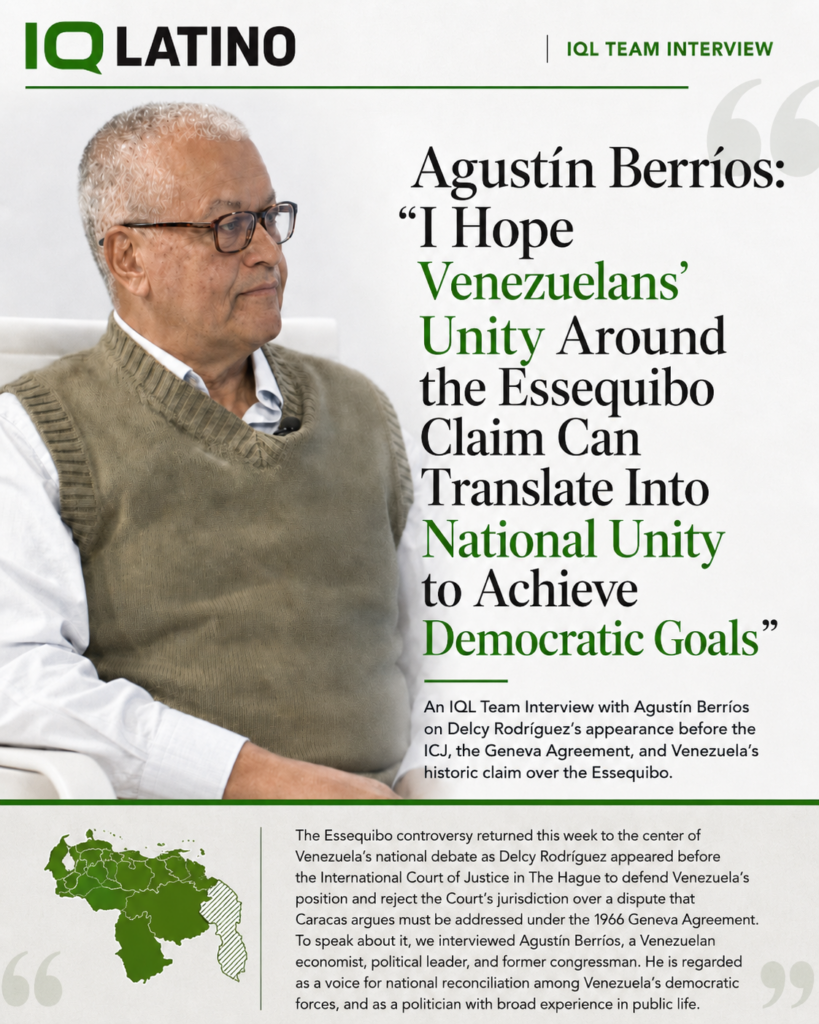
An IQL Team Interview with Agustín Berríos on Delcy Rodríguez’s appearance before the ICJ, the Geneva Agreement, and Venezuela’s historic claim over the Essequibo.
The Essequibo controversy returned this week to the center of Venezuela’s national debate as Delcy Rodríguez appeared before the International Court of Justice in The Hague to defend Venezuela’s position and reject the Court’s jurisdiction over a dispute that Caracas argues must be addressed under the 1966 Geneva Agreement.
The hearing placed Venezuela’s historic claim over the territory west of the Essequibo River back in the international spotlight. It also reopened a broader political question at home: whether an issue that has traditionally united Venezuelans across ideological and partisan lines can become a source of national cohesion at a moment when the country faces major decisions about democracy, sovereignty, economic stabilization, and its place in the Western Hemisphere.
To speak about it, we interviewed Agustín Berríos, a Venezuelan economist, political leader, and former congressman. Born in Niquitao, Trujillo, he graduated from the Universidad Central de Venezuela and holds a Master in Public Administration from Harvard University. He currently serves as acting president of the Partido de la Reconciliación Nacional. Berríos is regarded as a voice for national reconciliation among Venezuela’s democratic forces, and as a politician with broad experience in public life.
In this conversation with the IQL Team, Berríos reflected on Delcy Rodríguez’s appearance before the ICJ, the historical and legal foundations of Venezuela’s Essequibo claim, the centrality of the Geneva Agreement, and the possibility that Venezuelan unity around the Essequibo could also help inspire broader democratic goals at home.
IQL Team: Mr. Berríos, how do you describe Delcy Rodríguez’s appearance at the International Court of Justice in The Hague?
Agustín Berríos: I would describe it as her most presidential day in four dizzying months for Venezuela. We have seen events unfold with unusual speed: one day the U.S. Chargé d’Affaires arrives in Caracas to reopen the Embassy; another day the U.S. Secretary of Energy arrives; another day the first American Airlines flight lands; and then we hear that Venezuela has surpassed 1.2 million barrels per day in oil production.
Of course, all of this is connected. Nothing is accidental, although much of it may be fortunate. These events are tied together by History and Geography, two categories that define the politics of every country. Politics has always been, in part, geopolitics. But in these globalized times, politics is increasingly pure geopolitics.
IQL Team: Why does the Essequibo claim have such a powerful place in Venezuela’s national life?
Agustín Berríos: Because the Essequibo claim is one of the few issues capable of uniting Venezuela above its internal disputes. By attending the hearing before the ICJ, Delcy Rodríguez elevated the stature of her interim presidency above many debates over legitimacy, ideology, electoral timing, and other questions. Those matters are relevant, of course. But none of them has the same capacity to unite all Venezuelans as our claim over the Essequibo.
At The Hague, national politics came together in demanding justice for Venezuela. That demand comes from the two sources that make a people become a Nation, give that Nation the soul of a Motherland, and make that homeland, in our Western Hemisphere, assume the higher legal form of a Republic: a society of free men and women who decide how they are to govern themselves through institutions that protect and guarantee the liberty of all, far removed from every form of hegemony.
IQL Team: What is, in your view, the essence of Venezuela’s legal and historical position on the Essequibo?
Agustín Berríos: Venezuela, as Nation, as Motherland, and as Republic, claims from geography, history, and law that the territory west of the Essequibo River belongs to us.
The Paris Arbitral Award, which purported to dispossess Venezuela of that territory, is null and void. It was a crude scheme carried out behind the back of a defenseless country at a very precarious moment in its republican life, when military caudillos were dismantling its institutions. The memoranda of Judge Mallet-Prevost provide irrefutable force to Venezuela’s denunciation of that scheme.
IQL Team: Why is the Geneva Agreement of 1966 so central to Venezuela’s position?
Agustín Berríos: Venezuela’s long struggle against the dispossession imposed by the Paris Award reached its highest point — at least so far — in 1966. That year, Venezuela achieved something extraordinary: it forced powerful England to admit, by signing the Geneva Agreement and requiring Guyana to sign it before granting its independence, that the Paris Award had serious questions surrounding it.
That was a major diplomatic achievement. It recognized that Venezuela had a well-founded controversy and that both Guyana and Venezuela were required to find a “mutually acceptable solution.”
IQL Team: Who were the Venezuelan leaders associated with that diplomatic achievement?
Agustín Berríos: The President was Raúl Leoni. The Foreign Minister was Ignacio Iribarren Borges. Venezuela’s Ambassador in London was Héctor Santaella.
A delegation traveled for the signing that reflected Venezuela’s political plurality. Among its members were Luis Herrera Campins and Jaime Lusinchi, both of whom would later be elected President of the Republic. That detail matters because the Essequibo claim was not the cause of one party or one government. It was a national cause.
IQL Team: How did Venezuela later respond to the Protocol of Port of Spain?
Agustín Berríos: Years later, during President Rafael Caldera’s first administration, the government signed the so-called Protocol of Port of Spain, which suspended the application of the Geneva Agreement. But Venezuela’s political forces rejected parliamentary approval of that Protocol. This time, even the communists joined that rejection.
The country rallied again around the validity of the Geneva Agreement as the only legal instrument to resolve the controversy caused by the outrage committed against Venezuela in Paris in 1899.
IQL Team: Do you believe the spirit of 1966 was present again at the ICJ hearing?
Agustín Berríos: Yes. That milestone, which united Venezuela in 1966, unites it again today when the absolute and inalienable validity of the Geneva Agreement is invoked before the ICJ.
Once again, Geography and History unite us. And geopolitics should favor us as well, provided we have the minimum intelligence to understand it.
It is not the same for Venezuela to go before the ICJ in confrontation with, and without relations with, the United States, as it is to appear — as we did — as a friendly and allied nation of the leading country of the Western Hemisphere. Venezuela and Guyana both belong indissolubly to that hemisphere. And both are bound, by the Geneva Agreement, and also by Geography and History, to reach a “mutually acceptable solution.”
IQL Team: Can Venezuelan unity around the Essequibo claim translate into broader national unity around democratic goals?
Agustín Berríos: I hope Venezuelans’ unity around the Essequibo claim can translate into national unity to achieve democratic goals.
The united gaze of Venezuela rested on that courtroom as the President demanded justice and denied the jurisdiction of the ICJ in a controversy whose treatment is defined by the Geneva Agreement. That same gaze can also turn inward, toward other acts linked to values that run across the national soul. Freedom is one of them. Peace and progress are others.
The Geneva Agreement offers many lessons, and also many opportunities. Hopefully, the spirit of The Hague will also be expressed here at home, in other acts of national unity.