

In 1998, acting on behalf of most of the political blocs represented in Venezuela’s Congress, I submitted one of the briefs defending the constitutionality of the congressional resolution that had authorized risk-based exploration and production associations on July 4, 1995—the policy then known as the Apertura Petrolera, or Oil Opening. PDVSA’s legal team included Allan Brewer-Carías and Román Duque Corredor; Congress was represented by the Office of the Prosecutor and its legal advisers, including Iván Darío Badell, Jesús María Casal, and Carlos Leañez. I entered the case after serving as counsel to the Energy and Mines Committee, chaired by Congressman Ramón José Medina. Our argument was straightforward: Venezuela could create a legal vehicle for private investment in oil production without surrendering sovereignty, provided the state retained authority over the resource even if it did not directly control day-to-day operations. That framework, we argued, was fully consistent with the Constitution and with Article 5 of what was then known as the Oil Nationalization Law.
Among the challengers were Fundapatria, led by Luis Vallenilla, together with Alí Rodríguez Araque and Adina Bastidas—figures aligned with Hugo Chávez’s emerging political movement. They lost the case: in August 1999, the Supreme Court rejected every challenge. History, however, handed the losing side political power. After Chávez won the presidency, Bastidas became vice president; Rodríguez became energy minister and later president of PDVSA. A new Constitution followed in December 1999. From government, they eventually achieved what they had failed to obtain in court. In 2007, the state forced existing projects to migrate into mixed companies under majority state control. Chevron accepted minority status and remained. ExxonMobil and ConocoPhillips refused, left the country, and later secured multibillion-dollar arbitral awards against Venezuela. The contrast in outcomes is stark: Venezuela produced close to three million barrels per day in 1996, and the Oil Opening was designed to push output beyond five million. That strategy was abandoned in 2007. Today, the country produces only a fraction of what it did then.
I revisit that history because it explains the consistency of my position on the proposal now before the country. The principle I defended between 1995 and 1999 is the same one I defend today: a legal arrangement that brings private capital into the oil industry does not violate national sovereignty if it preserves meaningful state authority over the resource and safeguards the public interest.
Sovereignty does not mean leaving oil underground. For too long, Venezuela confused sovereignty with absolute state control—even when that control generated neither investment nor public welfare. It would be equally misguided to replace that dogma with its mirror image: the notion that every form of opening is desirable merely because it attracts capital. Proposals to privatize PDVSA outright, eliminate the state’s reservation over this strategic sector, or weaken public ownership of hydrocarbon deposits go too far in the opposite direction. Real sovereignty lies in establishing rules that convert state-controlled energy resources into broad-based prosperity through private participation while protecting the national interest.
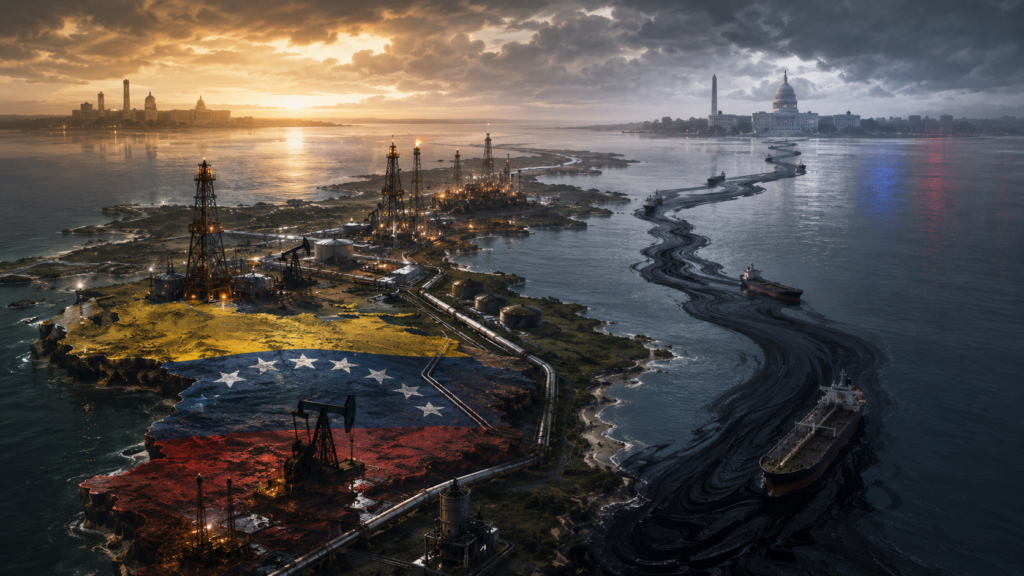
The agreement now being discussed should therefore be judged by the instruments that give it legal effect, not by slogans surrounding it. Public announcements point to an energy partnership involving a private operator and the U.S. government to develop 17 fields assigned by PDVSA. Those fields reportedly contain 65 billion barrels of proven potential—roughly one-fifth of Venezuela’s reserves. The Venezuelan and U.S. governments project more than $100 billion in investment and approximately $200 billion in royalties and taxes over the next 25 years. Worth noting: in addition to generating fiscal revenue for the Republic, PDVSA also gets a share of the oil produced by the CPP or a fee that compensates it for the exploitation rights. It is also important to keep the scale in perspective: Venezuela has many other fields and reserves under state ownership, some already assigned and others still available for development by additional operators.
The recent reform of the Organic Hydrocarbons Law created Productive Participation Contracts, known by their Spanish initials as CPPs, to attract private capital while preserving state ownership of the deposits and PDVSA’s control over the association. The operator identified by Washington is North American Blue Energy Partners, or NABEP, currently the country’s second-largest privately capitalized oil producer. The White House has referred to the rights granted to the company as “concessions,” although the applicable Venezuelan instruments are CPPs for 50 years, renewable once for an equal term. The reformed law itself does not impose a maximum duration on CPPs.
According to the facts released by the White House, Washington would acquire a 35 percent equity stake in NABEP through the Office of Strategic Capital within the U.S. Department of War. The United States would also receive a guaranteed right to purchase 20 percent of the company’s production at cost and a right of first refusal over the remaining 80 percent. Our preliminary investigation is that the definition of cost for the 20 percent of the output includes the royalties payable to the government of Venezuela, and that under the tax laws, regardless of the letter of the agreement, income tax and oil production tax laws shall use market prices as the reference for tax computation — creating a cost to NABEP without impacting Venezuela’s fiscal revenue.
The stated purpose is to strengthen the U.S. Strategic Petroleum Reserve. The Department would hold veto rights over appointments to NABEP’s board, whose members would be predominantly U.S. citizens, while the corporate-governance arrangements would be governed by U.S. law and subject to U.S. courts. The White House has also stated that most of the newly assigned fields had previously been held by Russian and Chinese interests.
A fundamental political distinction follows. This is not an association entered into by Donald Trump in his personal capacity; it is an agreement involving the United States. If properly structured, its rights and obligations will survive the administration currently occupying the White House. The same must be true on the Venezuelan side: the obligations cannot rest on Delcy Rodríguez’s political will, but on the commitments undertaken by the participating company and by PDVSA under the relevant CPPs. The two countries have converging interests. The United States wants to diversify secure sources of supply. Venezuela needs capital and expertise to rehabilitate an industry weakened by corruption, disinvestment, and sanctions.
Two objections deserve particular attention. The first concerns opacity. The discretion surrounding these arrangements results from the coexistence of U.S. sanctions and licenses with Venezuela’s Constitutional Anti-Blockade Law, which empowers the executive branch to suspend, in secret, the application of rules that impede transactions affected by sanctions. The paradox is difficult to ignore: a law originally designed to circumvent Washington’s sanctions now shields from public scrutiny the very contracts Washington ultimately approves through licenses or direct agreements with operators in Venezuela. That is why I have argued that the durable remedy is to lift sanctions in exchange for a clear, negotiated electoral horizon during the transition.
The second objection concerns the legitimacy of the Venezuelan authority making commitments that could bind the country for decades. Can an acting government do so? Any answer must begin with the exceptional circumstances that produced the present arrangement: a de facto U.S. tutelage following the military intervention and the capture of Nicolás Maduro. President Trump formally recognized Delcy Rodríguez as Venezuela’s head of state and government, a position the State Department has placed on the record in judicial proceedings. At the same time, negotiations have brought together the National Assembly elected in 2015 and the one elected in 2026. The former—recognized by the United States as the last legally and legitimately elected national authority—has accepted the current Assembly as an institutional interlocutor under U.S. mediation.
This week, the 2026 Assembly debated and approved the agreement by majority vote, as Article 150 of the Constitution requires for contracts of national public interest. Domestically, and notwithstanding the electoral fraud of 2024, the acting government rests on a Constitutional Chamber ruling issued by the Supreme Tribunal of Justice on January 4, 2026. That arrangement has been accepted by the United States and dozens of foreign governments. It is uncomfortable, imperfect, and open to legitimate debate—but it is the situation that exists. To insist that only a new government possessing full democratic legitimacy may negotiate would, in practice, postpone every major agreement Venezuela needs to stabilize its economy and make the transition itself viable.
This partnership is also intended to catalyze others. The same week brought the conclusion of several energy negotiations: Chevron announced $7 billion in new investment, and roughly a dozen independent producers prepared to enter a market that already includes multinational companies such as Chevron, Repsol, Shell, Eni, and Maurel & Prom.
For Venezuela, the most consequential figure may be the projected $200 billion in royalties and taxes from this NABEP-U.S. arrangement alone. Over the coming two decades, those revenues could help rebuild the electrical grid, hospitals, and schools and begin to address the immense social debt owed to the Venezuelan people. Yet oil revenue does not automatically produce democracy—or even competent government. The proceeds should be governed by transparent budgets, overseen by an independent Comptroller General, and supported by a national savings and stabilization fund. There is also no time to waste. Oil is a nonrenewable resource, and the global shift toward cleaner energy will not reverse itself. Venezuela cannot afford to develop its vast reserves at a leisurely pace while their strategic value erodes.
There is, nevertheless, a difference that should not be obscured. In 1996, opening the industry to private capital was an affirmative exercise of sovereignty, authorized by an elected Congress and intended to lift production from nearly three million to as much as six million barrels per day, with PDVSA then regarded as one of the world’s leading oil companies. Today, the same legal and economic principle is being invoked under extraordinary constraints to rescue the industry from a profound crisis. That leaves a different—and ultimately more important—question unresolved: how, and when, will political sovereignty return to the Venezuelan people so they can freely choose their government?
Looking at the full picture through the unsentimental lens of realpolitik, I find myself returning to General Eleazar López Contreras’s celebrated counsel during the political transition he led after 1935: “Calm and good judgment.” I also return to Rómulo Betancourt’s Venezuela: Oil and Politics—and, above all, to the phrase coined by his minister of mines and hydrocarbons, Juan Pablo Pérez Alfonzo, for oil itself: “the devil’s excrement.”
Leopoldo Martínez Nucete is an international lawyer, former Congressman in Venezuela, and former Counselor of the U.S. Department of Commerce during the Biden Administration.