

Trump has once again provoked controversy with the idea of turning Venezuela into the 51st state of the United States. Although it may be read as a provocation, a distraction, or an irresponsible act of media manipulation, it demands a forceful and unequivocal response. Not to play along with the spectacle, but to clearly establish what truly matters: Venezuela does not need annexation, subordination, or imperial fantasies. Venezuela needs to fully recover its democracy, its popular sovereignty, its constitutional legitimacy, and a serious, respectful, and productive relationship with the United States.
The idea must be examined through a constitutional lens. It does not depend on Trump. It does not even depend on a unilateral political will in Washington. And, above all, it does not depend on a fantasy of power that ignores the history, dignity, and sovereignty of the Venezuelan people.
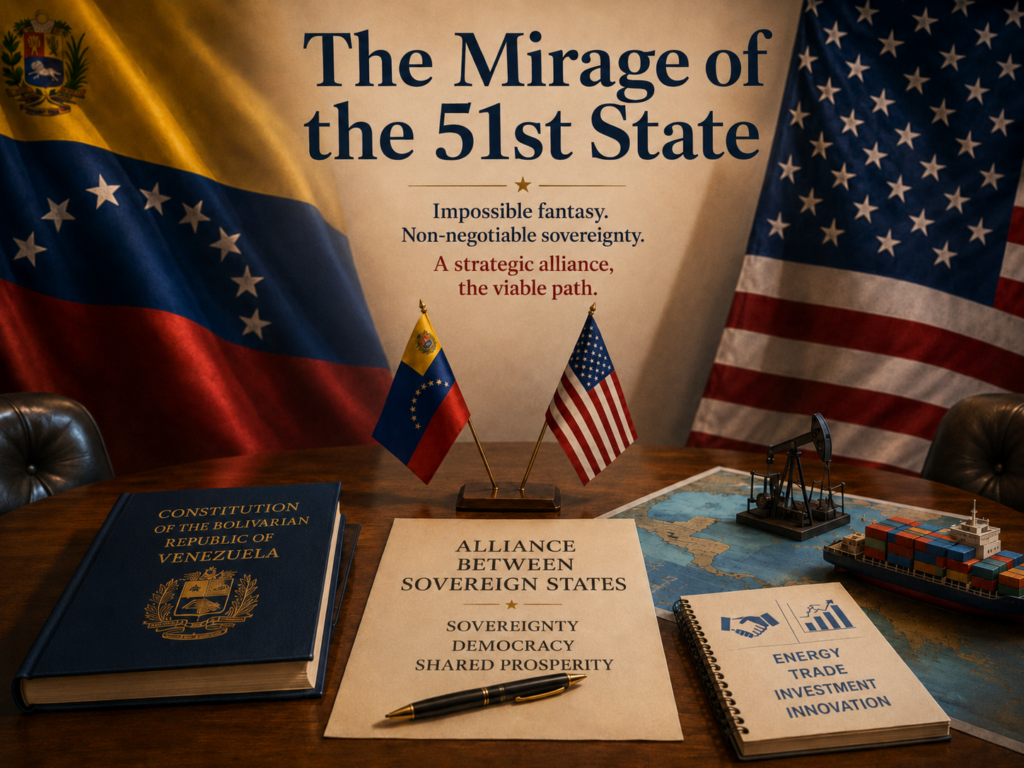
In Venezuela’s case, the difficulty would be even greater because this would not involve admitting a territory that is already part of the United States, but rather incorporating a sovereign foreign state. If the chosen route were a treaty of annexation, the approval of two-thirds of the Senate would be required; but such a treaty would not be enough to turn Venezuela into a state of the Union. State admission would then require an act of Congress under Article IV, Section 3. If the route of a joint resolution were attempted, as in controversial historical precedents, there would still be no unilateral presidential power: a formal decision by Congress would be required and, before all of that, valid Venezuelan consent. And there lies the decisive obstacle: Venezuela’s Constitution declares independence and sovereignty to be unrenounceable rights, establishes that sovereignty resides intransferably in the people, and prohibits the cession or alienation of national territory to foreign powers. Therefore, in Venezuela’s case, the idea is not only politically uphill; it is constitutionally unviable on both sides.
That is why I have insisted since the first time I heard Trump float this idea: Venezuela does not need annexation, subordination, or imperial fantasies. Venezuela needs to fully recover its democracy, its popular sovereignty, and its constitutional legitimacy.
The question, then, is a different one: why does Trump insist on saying something that does not depend on him and is constitutionally unviable?
The answer lies less in law than in politics. This kind of provocation allows Trump to present himself as the axis around which Venezuela’s future revolves. The implicit message is not necessarily that there is a serious plan for annexation. The message is that he places himself as the decisive actor: above Delcy Rodríguez, above María Corina Machado and the country’s entire democratic alternative, above any Venezuelan negotiation, and even above the institutional debate over a democratic transition. The image communicates power, control, and personal centrality.
That is precisely the trap. The conversation Venezuela needs is not whether some foreign leader can absorb it into his political map. He cannot. The urgent conversation is how to build an electoral, constitutional, and negotiated path for Venezuelans to recover democracy, in alignment with the process of stabilization and economic opening being advanced by the government of Acting President Delcy Rodríguez.
When the debate shifts toward annexation, it abandons the terrain where the democratic discussion must take place. Instead of talking about political prisoners, electoral conditions, elections, institutions, reconciliation, transitional justice, economic stabilization, and the protection and return of Venezuelan migrants, the country becomes trapped in a spectacle of wounded sovereignty.
There is also a human dimension that cannot be left out of this discussion: Venezuelan migration. Millions of Venezuelans did not leave their country because they wanted to renounce Venezuela. They did so because of institutional destruction, economic precarity, political persecution, insecurity, and lack of opportunity. More than 600,000 of those Venezuelan migrants are in the United States, rendered undocumented by an unjust Trump decision and exposed to harsh deportations and, in many cases, detention and violations of their human rights. Turning the debate into a geopolitical joke about the “51st state” offers no credible answer to that drama. It does not respond to the heartbreaking plight of the Venezuelan who crossed the Darién, who awaits immigration justice or an opportunity to organize a return without the pressure of imminent deportation, who supports family members through remittances, who wants to return but cannot, or who fears returning to a country without guarantees.
A serious policy toward Venezuela should ask how to create the conditions for those Venezuelans to live with dignity wherever they are and, if they so wish, return to a democratic, stable, and prosperous Venezuela. That requires responsible migration protection, social and labor integration in host countries, regional cooperation, and, above all, a political strategy that addresses the cause of the exodus: the absence of democracy, reliable institutions, and economic opportunity in Venezuela.
That is why two deviations must be rejected with equal clarity: annexationist fantasy and authoritarian nationalism. Venezuela must not be treated as a colony, a geopolitical trophy, or a piece in a personal negotiation. But neither can the regime be allowed to use the defense of sovereignty as an excuse to deny the real sovereignty of the Venezuelan people: the sovereignty expressed through free elections, legitimate institutions, guaranteed rights, and citizens capable of deciding their own destiny.
Venezuelans feel deep pride in their sovereignty. The aspiration of the Venezuelan people is not dependency, but a stable democracy, a prosperous economy based on the country’s vast potential, and a constructive and independent role in the hemisphere. Venezuelans value a strong and respectful relationship with the United States, but never at the expense of national dignity or self-determination.
From there emerges an alternative far more serious than any provocation: a strategic partnership between Venezuela and the United States to build a new energy, trade, and economic relationship. Venezuela has one of the world’s largest energy reserves, hydroelectric potential and minerals of every kind, including rare earths, a privileged geographic location with a coastline stretching from the Caribbean Sea to the Atlantic, an entrepreneurial society, a global diaspora, and extraordinary potential for reconstruction. The United States, as the great power it is, has capital, technology, markets, institutional capacity, and a legitimate interest in the hemisphere’s democratic and economic stability.
But that relationship can only be sustainable if it is built on mutual respect. Not on subordination. Not on tutelage. Not on the imposition of a political model from the outside. A new chapter between Venezuela and the United States must be based on the sovereignty of both countries, transparency, legal certainty, responsible economic opening, the protection of human rights, and international support for a democratic transition decided by Venezuelans.
Energy and economic normalization are part of the solution if they are tied to a democratic horizon. They can help stabilize the country, recover infrastructure, attract investment, rebuild productive capacity, and alleviate the social crisis. They can also offer a path for Venezuela to once again become a country capable of receiving its diaspora. But if they are separated from a political route, they risk becoming a mere transaction: oil without democracy, business without institutions, stabilization without legitimacy. That would be a historic mistake.
Trump may provoke with maps and strident phrases. But Venezuela’s constitutional history does not fit inside a viral image. Venezuela will not be the 51st state. Venezuela will be a democratic, sovereign republic reconciled with itself.
The task of our time is not to surrender sovereignty. It is to recover it for the citizens. And that will only happen through a constitutional, electoral transition by and for Venezuelans, supported by an international community that respects Venezuela.
Leopoldo Martínez Nucete is an international lawyer and former Venezuelan congressman. He is the founder of the Center for Democracy and Development in the Americas (CDDA) and served as Senior Counselor at the U.S. Department of Commerce during the Joe Biden administration.