

For this reason, maintaining TPS for Venezuelans, or alternatively issuing a Deferred Enforced Departure (DED) designation, is not a political gesture—it is a moral obligation and a sound policy decision.
The case of Carlos García, former mayor of Mérida and a political persecution victim in Venezuela, is not an anomaly. It is a symptom of an immigration policy that, rather than protecting vulnerable populations, punishes them—one that replaces nuance and due process with arbitrariness. His detention, despite having ongoing legal proceedings, is part of a growing pattern in which Venezuelans are deprived of liberty under circumstances that defy common sense, due process, and the humanitarian values the United States claims to uphold.

In recent months, multiple cases have been documented involving Venezuelans with Temporary Protected Status (TPS), humanitarian parole, or pending asylum claims who have been detained by ICE after appearing at court hearings, reporting to immigration offices, or even while present in sensitive locations such as hospitals. Students, workers with no criminal records, and families with years of lawful residence have been arrested abruptly—sometimes immediately after complying with all legal requirements imposed by the immigration system.
Particularly alarming has been the use of the detention facility known as Alligator Alcatraz in Florida. Testimonies from Venezuelans held there—some later released—describe degrading conditions, criminalizing treatment, and a complete lack of proportionality, even in cases where legal status remained valid or was actively being litigated. Detaining TPS holders and individuals with humanitarian protections in such facilities not only undermines confidence in the system but sends a clear message of persecution rather than protection.
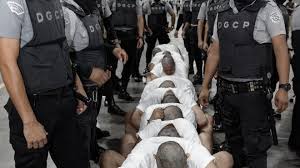
Compounding these abuses is an even more troubling development: more than 17,000 Venezuelans have been deported on direct flights to Venezuela in recent months, often without individualized assessments of their circumstances. This includes the horrific case of 252 Venezuelans, the vast majority of whom had legal status and no criminal records, who were deported to El Salvador’s CECOT, a maximum-security prison widely criticized for violating minimum human rights standards, before being subsequently deported to Venezuela—after months of abuse and, in documented cases, torture while in the custody of the Salvadoran government.
If you want a more legalistic or more journalistic version, I can calibrate the tone further. These mass deportations have occurred despite documented cases of political persecution, pending asylum claims, and clear humanitarian risks, reducing complex human stories to logistical operations. The result is a return policy that ignores real dangers and violates fundamental principles of international protection.
All of this is happening while Venezuela, even after the U.S. military operation that captured Nicolás Maduro on January 3 and brought him to justice in New York on federal drug trafficking and related charges, continues to lack a clear democratic transition. The so-called “stabilization” phase announced by Secretary Rubio is not democracy. Political repression persists now with a selective pattern, and despite human rights organizations having verified that 156 (out close to of 800) political prisoners have been released since January 8, many of whom remain subject to arbitrary judicial proceedings, conditional freedoms, travel or speech restrictions, and the constant threat of re-incarceration. Electoral guarantees remain absent, and institutional collapse continues to make safe return impossible for most. To suggest that these conditions justify the abrupt termination of TPS or humanitarian parole is, at best, a convenient fiction.
From both a legal and humanitarian perspective, the argument is straightforward: a government cannot abruptly strip protection from entire populations who built their lives under a legal status it itself granted, and then subject them to arbitrary detention or collective deportation, exposing them to dire conditions (and in some cases potential persecution) and family separation. This is especially indefensible when such decision to revoke TPS are still being challenged in court and no viable alternative form of relief has been offered.
For this reason, maintaining TPS for Venezuelans, or alternatively issuing a Deferred Enforced Departure (DED) designation, is not a political gesture—it is a moral obligation and a sound policy decision. DED designaton could be expeditious because it is an authority reserved exclusively to the President of the United States, exercised under the President’s constitutional power over foreign relations and not delegated by statute to any other official or agency. A DED designation would provide temporary protection, legal stability, and a minimum level of certainty for hundreds of thousands of families while Venezuela’s future is determined honestly and responsibly, and change is both aiming towards democratization and economic opportunity. The DED designation should be accompanied by the release of all migrants currently detained by ICE, with the exception of individuals with proven criminal convictions or record.
The United States has, at other moments in its history, acted with pragmatism and humanity in response to international crises. Today, in the face of Carlos García’s case and those of countless Venezuelans rendered invisible by statistics and case files, the question is simple: will the country continue punishing those who followed the rules, or will it rise to the values it professes?
The answer cannot be arbitrary detention or legal limbo. It must be temporary protection, due process, and time—time for Venezuela to genuinely change, and time for these families to decide their future without fear.