

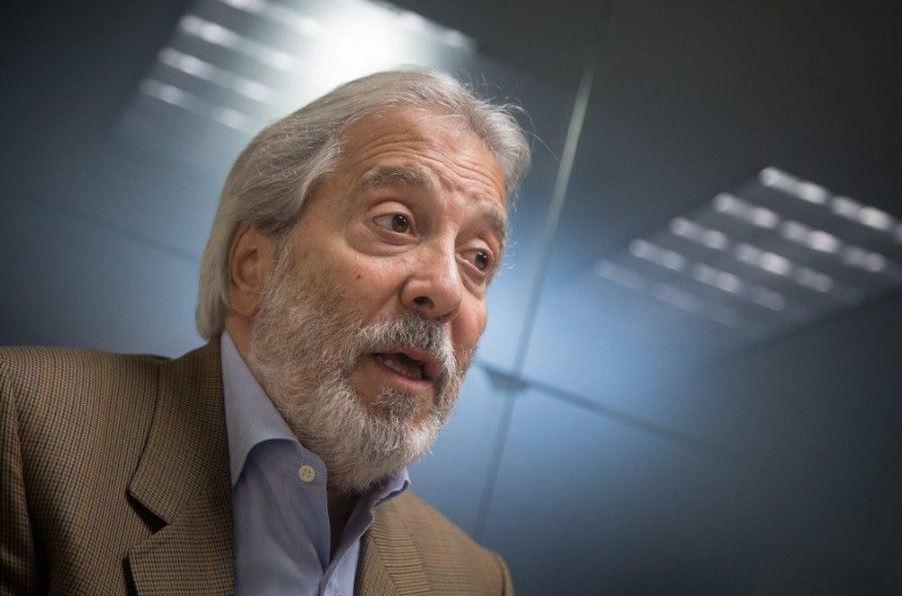
Ramón José Medina has spent decades at the center of Venezuelan public life. He served as deputy secretary of the Democratic Unity Roundtable (Mesa de la Unidad Democrática, MUD), represented his country in Congress for four terms, and was General Counsel to the Ministry of Development during the presidency of Luis Herrera Campins. He has also maintained a successful private legal practice and longstanding ties to journalism, including many years on the board of El Nacional.
How does a country once admired across Latin America descend into institutional ruin? For Medina, Venezuela’s crisis cannot be reduced to economic collapse or political repression. It is the result of a deeper breakdown: the erosion of the rule of law, the destruction of democratic checks and balances, and the normalization of arbitrariness in public and private life. In this conversation with the IQLatino editorial team, prompted by his recently published and thought-provoking article “La crisis venezolana,” originally published by TalCual, he traces the country’s path from the democratic breakthrough of January 23, 1958, to its present impasse—and confronts the harder question of whether Venezuela can still recover its institutions, civic culture, and democratic future.
IQLatino: You recently wrote an article reflecting on democracy, political culture, and transitions, a central part of your work in Venezuela. You begin your reflection by invoking Mario Vargas Llosa’s famous question in Conversation in the Cathedral: “At what precise moment had Peru fucked itself up?” Why does that question resonate so strongly in Venezuela today?
Ramón José Medina: Because Venezuelans could ask ourselves essentially the same thing: When, how, and why did a country that was once admired by much of Latin America become a place defined by political uncertainty, profound economic crisis, and widespread social hardship?
It is difficult to identify a single moment. What we are experiencing is the cumulative result of a long process of institutional erosion, political irresponsibility, authoritarianism, and national disorientation. Venezuela did not collapse overnight. The deterioration unfolded gradually, until what once seemed exceptional became part of everyday life.
IQLatino: What are the most visible expressions of that deterioration?
Medina: Our institutions have been weakened to the point of near exhaustion. Competence has been displaced by improvisation, while authoritarianism has operated with almost complete impunity.
Democracy is not merely an electoral mechanism. It is also a system of coexistence and a way of organizing public life. It requires the rule of law, an effective separation and balance of powers, respect for minorities and dissent, and dialogue as the natural means of resolving disagreements.
In Venezuela, all these principles have been seriously undermined. Instead of institutional rules, we have lived under arbitrariness. Instead of democratic debate, we have seen verbal—and at times physical—aggression. Property rights have been violated, and violence has increasingly degraded social relations.
That is why the crisis is not exclusively political or economic. It is also institutional, social, and moral.
IQLatino: Are you suggesting that democracy itself is at risk beyond the current situation in Venezuela?
Medina: Absolutely. Democracy is endangered when the institutions that sustain it cease to function and when citizens begin to see arbitrariness as normal or inevitable.
A democratic society depends not only on formal institutions but also on habits of tolerance, restraint, dialogue, and mutual recognition. When those habits disappear, the damage extends far beyond government. It enters everyday life and affects the way citizens relate to one another.
Venezuela’s crisis therefore cannot be measured only through inflation, poverty, declining public services, or political repression. It must also be understood through the deterioration of our civic culture and our capacity to live together despite our differences.
IQLatino: Was this crisis imposed on Venezuelans, or does Venezuelan society also bear some responsibility for it?
Medina: The crisis did not fall from the sky. Pretending otherwise would be naïve. To a considerable extent, we brought it upon ourselves.
That does not mean distributing responsibility equally or excusing those who exercised power abusively. It means recognizing that the country arrived at this point through decisions, omissions, mistakes, and failures accumulated over time.
Any serious effort to rebuild Venezuela must begin with an honest examination of that history. Without memory and self-criticism, we run the risk of repeating the same errors under different names.
IQLatino: Why is January 23, 1958, so important to understanding the contrast between Venezuela’s aspirations and its present condition?
Medina: January 23 marked the beginning of a new stage in Venezuelan history. After decades of dictatorship, democracy became the country’s great national ideal.
When the dictator fled, Venezuelans celebrated more than the fall of one government. They celebrated a collective victory and the possibility of constructing a political system based on freedom, pluralism, and civilian institutions.
That democratic aspiration helped define Venezuela for decades. It created the expectation that political conflict could be resolved through institutions rather than violence, and that power could be exercised within constitutional limits.
The tragedy is that much of that institutional inheritance was subsequently weakened or destroyed.
IQLatino: Looking at the depth of the crisis, is it still reasonable to believe that Venezuela can recover?
Medina: That is the unavoidable question: Does this situation have a solution? Are there still reasons to look toward the country’s future with hope? What is Venezuela’s destiny as a nation?
There are no easy answers. The damage is profound, and recovery will require much more than a change in rhetoric or political leadership. It will require rebuilding the rule of law, restoring institutional balance, recognizing pluralism, protecting citizens and their property, and making dialogue once again a legitimate instrument of national understanding.
Hope cannot rest on denial. It must begin with a clear recognition of what happened and of the responsibilities that brought us here.
IQLatino: What, then, should be the starting point for a national recovery?
Medina: We must recover democracy not only as a political system but also as a way of life.
That means learning again to respect disagreement, to recognize political adversaries without treating them as enemies, and to submit power to laws and institutions. Venezuela must replace arbitrariness with rules, aggression with dialogue, and impunity with accountability.
The democratic promise of 1958 cannot simply be remembered with nostalgia. It must be reconstructed for a new generation and adapted to the realities of today’s country.
The question is not only when Venezuela went wrong. The more important question now is whether Venezuelans are prepared to understand why it happened—and whether we have the determination to build a different future.