

Datincorp’s October poll finds continued preference for negotiation, declining approval of Trump’s strategy, divided views on dollarization and substantial openness to constitutional change.
By the IQ Latino Editorial Team
Economic hardship remains Venezuelans’ leading concern, while confidence in the country’s direction, the government’s performance and the results of political negotiations has weakened since August, according to Datincorp’s October national survey.
The findings portray an electorate that continues to favor negotiated change but increasingly questions whether current arrangements—including engagement between Washington and Caracas—will deliver benefits for Venezuela.
Conducted on October 4 through face-to-face household interviews with 1,200 registered voters, the survey also reveals persistent demand for new leadership, closely divided preferences over the country’s monetary future and plurality support for a constituent assembly.
Inflation income and employment remain the biggest priority
Asked which issue they would address most urgently if they were president, 46.2% select economic problems, grouped in the questionnaire as inflation, income and unemployment. That compares with 51.5% in August—a decline of 5.3 percentage points, but still comfortably the largest response.
Medical and hospital services follow at 14.6%, compared with 15.5% in August. Electricity has become almost equally urgent, rising from 7.4% to 14.5%. Political issues, including elections, political prisoners and party legalization, move from 8.4% to 9.5%.
The decline in the economic category does not establish that inflation or living conditions have improved. Respondents were choosing their most urgent priority, and electricity gained prominence. The survey groups inflation, income and unemployment together, so it cannot determine how much of the economic response is attributable to each concern.
Household findings reinforce the persistence of financial pressure. Some 53.9% identify income among the aspects of their lives that deteriorated most during the previous year, little changed from 55.2% in August. Only 17.9% say their families progressed, while 51.6% stayed in the same position and 29.1% fell behind.
Economic relief remains central to public expectations, with electricity increasingly competing for immediate attention. The lower ranking of political issues measures urgency rather than the overall importance Venezuelans attach to democracy or political rights.
National expectations deteriorate
A majority—51.1%—now says Venezuela is worse than a year ago, up from 41.5% in August. The share describing the country as much worse has risen from 14.9% to 25.8%.
Looking ahead, 28.8% expect the country’s situation to be excellent or good in a year, compared with 36.1% in August. Those expecting bad or very bad conditions increase from 13.0% to 20.7%.
Personal optimism remains stronger than optimism about the country, but it has also softened. Some 52.8% expect their own and their family’s circumstances to improve over the next year, down from 57.4%. The share anticipating that their circumstances will be much better falls from 25.3% to 18.3%.
Willingness to emigrate has increased. Respondents who would leave, are considering departure or already have concrete plans to leave account for 39.8%, compared with 34.2% in August. Nevertheless, 58.5% say they would stay even if they had a real opportunity to leave, down from 63.6%.
Together, these changes suggest that hope persists, but confidence in improvement is becoming harder to sustain.
Negotiation remains preferred while confidence in results falls
Negotiated agreements between the government and opposition, with gains for both sides, remain the most realistic route to change for 47.8%, compared with 51.2% in August. That movement is within Datincorp’s stated approximate four-point comparison margin.
Negotiation attracts more than twice the support of confrontation aimed at removing the government, selected by 22.9%. Another 9.9% favor intervention by other countries, while 8.7% prefer waiting for the government to collapse.
The clearer change concerns expectations about the current talks. Those anticipating major changes fall from 21.1% to 14.2%, while respondents expecting no results increase from 31.1% to 38.9%. Another 39.2% expect limited changes, compared with 41.2% in August.
Approximately 53% therefore still anticipate at least some progress, but that share has fallen from roughly 62%.
A similar proportion believes Chavista and opposition leaders can cooperate on reconstruction: 16.8% say it is possible, and 36.3% say it is difficult but possible. Another 44.1% consider it impossible.
The electorate continues to favor agreements over confrontation, while growing more skeptical about their effectiveness.
An opening for constructive US engagement with clear limits
These preferences provide indirect evidence of an opening for American diplomacy that helps facilitate a negotiated solution. They do not establish a majority endorsement of Washington’s role or current policy.
The questionnaire describes negotiations involving the government and some opposition sectors with the United States acting as guarantor. That question measures awareness rather than approval: 60.3% say they know little or nothing about the process.
Support for negotiation and expectations of some progress are consistent with potential acceptance of constructive U.S. involvement. They cannot be translated into a percentage supporting American engagement, and the groups expressing those views overlap.
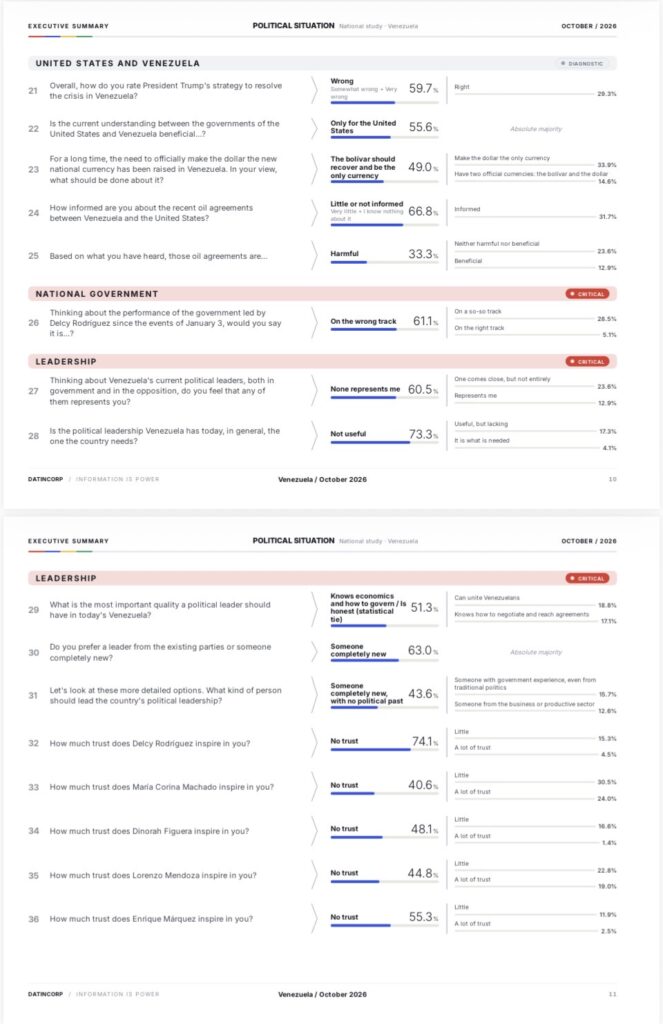
Direct assessments of Trump’s strategy have deteriorated sharply. Some 59.7% consider it mistaken, compared with 37.2% in August, while favorable assessments fall from 48.3% to 29.3%, according to Datincorp’s combined figures.
A majority—55.6%—now believes the understanding between the two governments benefits only the United States, up from 33.1%. The share saying it benefits both countries equally falls from 49.7% to 28.0%. Another 3.3% believe it benefits only Venezuela.
The findings suggest potential acceptance of U.S. engagement that contributes to agreements and tangible Venezuelan gains, alongside declining approval of the current strategy. They do not establish whether critics want Washington to disengage or change course.
Oil agreements face skepticism and limited public awareness
Two-thirds of respondents—66.8%—say they know little or nothing about the recent oil agreements between Venezuela and the United States.
Asked to assess them, 33.3% describe the agreements as harmful to Venezuela, 12.9% as beneficial and 23.6% as neither harmful nor beneficial. Another 28.6% say they know nothing about them, and 1.7% do not answer.
Negative assessments substantially exceed positive ones, although they do not constitute a majority of all respondents. Neutrality and lack of information cannot be treated as approval.
Together with the growing perception that the bilateral relationship benefits Washington disproportionately, the results suggest a need for greater transparency and visible domestic benefits. The survey does not determine whether limited information causes skepticism.
These oil-agreement questions are new in October and do not provide a direct August comparison.
Dollarization divides public opinion
Venezuelans are almost evenly divided over their monetary future. Some 33.9% favor making the U.S. dollar the sole official currency, while 14.6% support having both the dollar and bolívar as official currencies.
Together, 48.5% favor an official role for the dollar, compared with 49.0% who believe the bolívar should recover and remain the sole currency.
The findings reveal substantial acceptance of the dollar as a monetary option, alongside an equally strong preference for restoring the national currency. In a survey where inflation, income and employment remain the leading concern, this division makes monetary policy a relevant issue without identifying a clear majority for either approach.
The question measures preferences about formal currency arrangements rather than actual dollar use in everyday transactions. Support for an official role for the dollar should not be interpreted as endorsement of U.S. foreign policy. This question is also new in October.
A constituent assembly attracts a plurality
The proposal to convene a National Constituent Assembly to amend the current constitution receives support from 45.1%, while 27.3% disagree and 19.9% express indifference.
The proposal therefore attracts a substantial plurality, although support falls short of an outright majority.
The question links a constituent assembly to constitutional amendment as a solution to Venezuela’s crisis. It does not establish support for an entirely new constitution, a particular constitutional model or the rules governing an assembly.
The finding suggests openness to institutional change while leaving its scope and design unresolved. It also cannot automatically be read as support for the political actors who might seek to lead that process. As a new October question, it provides no measure of change since August.
Government dissatisfaction deepens as demand for renewal persists
Negative assessments of the government headed by Delcy Rodríguez increase from 53.0% to 61.1%. The share giving its performance an intermediate assessment falls from 37.3% to 28.5%, while those saying it is on the right track remain nearly unchanged at 5.1%, compared with 5.3%.
Discontent extends across the political system. Some 60.5% feel represented by none of the current leaders, and 63.0% prefer someone completely new to a leader from existing parties. Those measures remain broadly stable compared with August.
Political independence also persists: 65.6% describe themselves as independent or non-aligned, compared with 64.5%. Meanwhile, identification with no political party rises from 66.4% to 70.8%.
María Corina Machado nevertheless strengthens her position as the listed figure considered most capable of leading change and a transition, rising from 33.3% to 38.8%. Lorenzo Mendoza receives 16.2%, compared with 16.7%, and Delcy Rodríguez 5.3%, compared with 5.8%. Another 24.8% select none of the listed leaders.
Machado’s improvement on transition capacity does not coincide with an increase in strong personal trust, which remains broadly stable at 24.0%, compared with 25.0% in August. Meanwhile, 40.6% say she inspires no trust, down from 43.3%—a change within the survey’s stated comparison margin—underscoring that her lead on perceived transition capacity coexists with substantial distrust. These measures capture different judgments, and neither constitutes voting intention.
Business leader Lorenzo Mendoza is considered the second figure most capable of leading change and a transition after Machado by 16.2% of respondents, broadly unchanged from 16.7% in August. Some 19.0% express a lot of trust in him and 22.8% little trust, compared with 21.2% and 25.5%, respectively, in August. Meanwhile, 44.8% express no trust, up from 38.8%, and 10.2% say they do not know him. His stable position on perceived transition capacity therefore coexists with increased distrust.
Enrique Márquez receives 1.6% as the figure most capable of leading a transition, compared with 1.8% in August; 2.5% express a lot of trust in him and 11.9% little trust, while 55.3% express none and 26.8% say they do not know him.
Other leadership assessments deteriorate. Respondents expressing no trust in Dinorah Figuera increase from 38.3% to 48.1%, while strong trust falls from 7.7% to 1.4%. Those expressing no trust in Mendoza rise from 38.8% to 44.8%, despite his stable position on perceived transition capacity.
The October survey portrays mounting frustration with outcomes rather than a wholesale change in political identity. Economic concerns remain paramount, electricity has become more urgent, and confidence in the country’s direction and the effectiveness of negotiations has weakened.
For Venezuelan leaders and international partners, the findings point toward public demand for practical improvement and credible agreements. For the United States, a constructive diplomatic role remains possible, but confidence will depend on whether engagement produces benefits Venezuelans can recognize in their own lives.
Methodology and source
Datincorp reports 1,200 face-to-face household interviews across six Venezuelan regions, with fieldwork dated October 4, 2026. The survey covers registered voters in selected municipalities and uses a semi-probabilistic, four-stage, unweighted design. The firm reports an approximate maximum sampling error of ±2.8 percentage points at a 95% confidence level and an approximate ±4-point margin for differences between waves. August comparisons are drawn from the October report’s tracking of its August 23 survey. Small discrepancies in combined percentages and changes reflect rounding. Two waves establish a change between survey dates rather than a sustained trend.
Source: Datincorp, National Diagnosis of the Political Situation, Venezuela, October 2026, including comparisons with August 23, 2026.